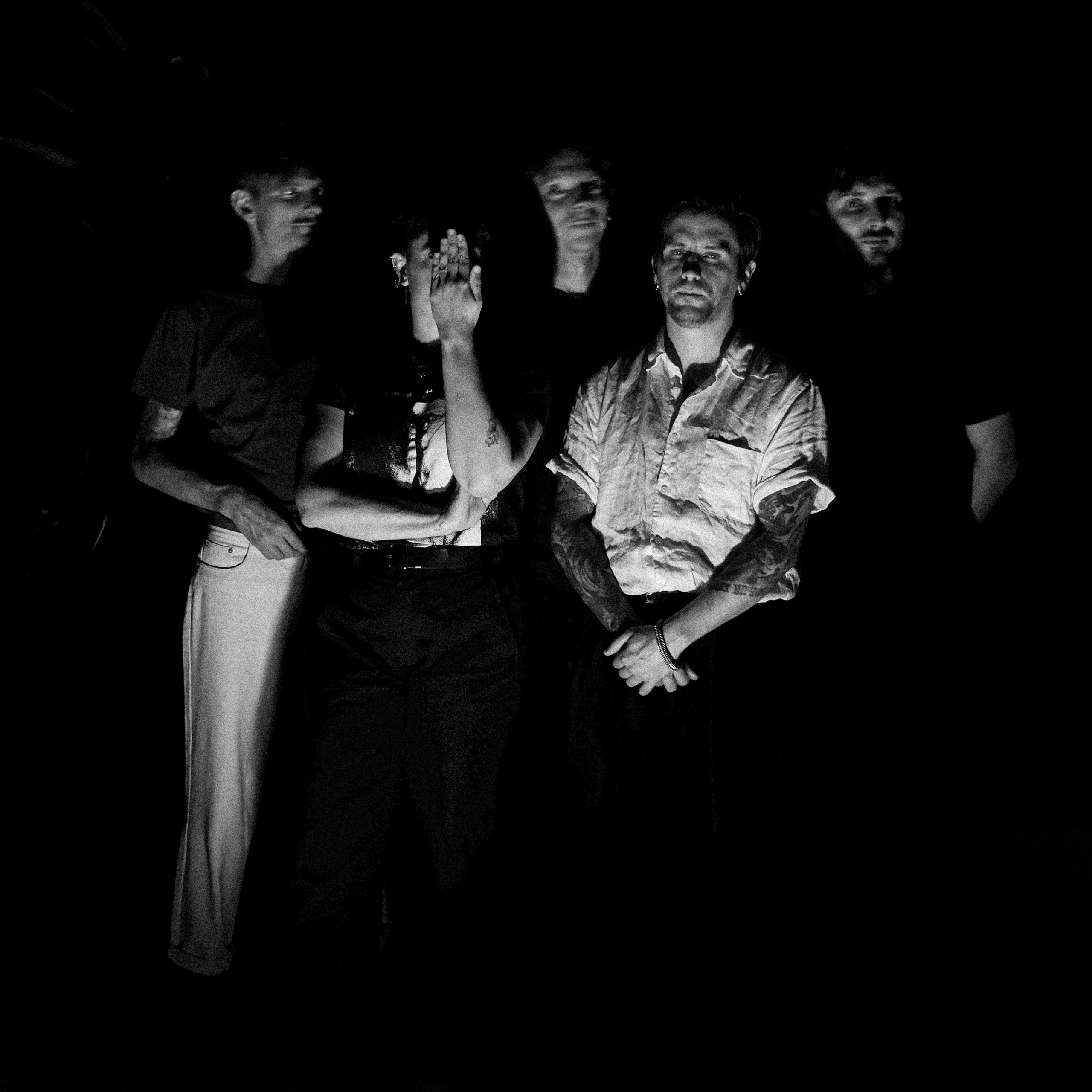
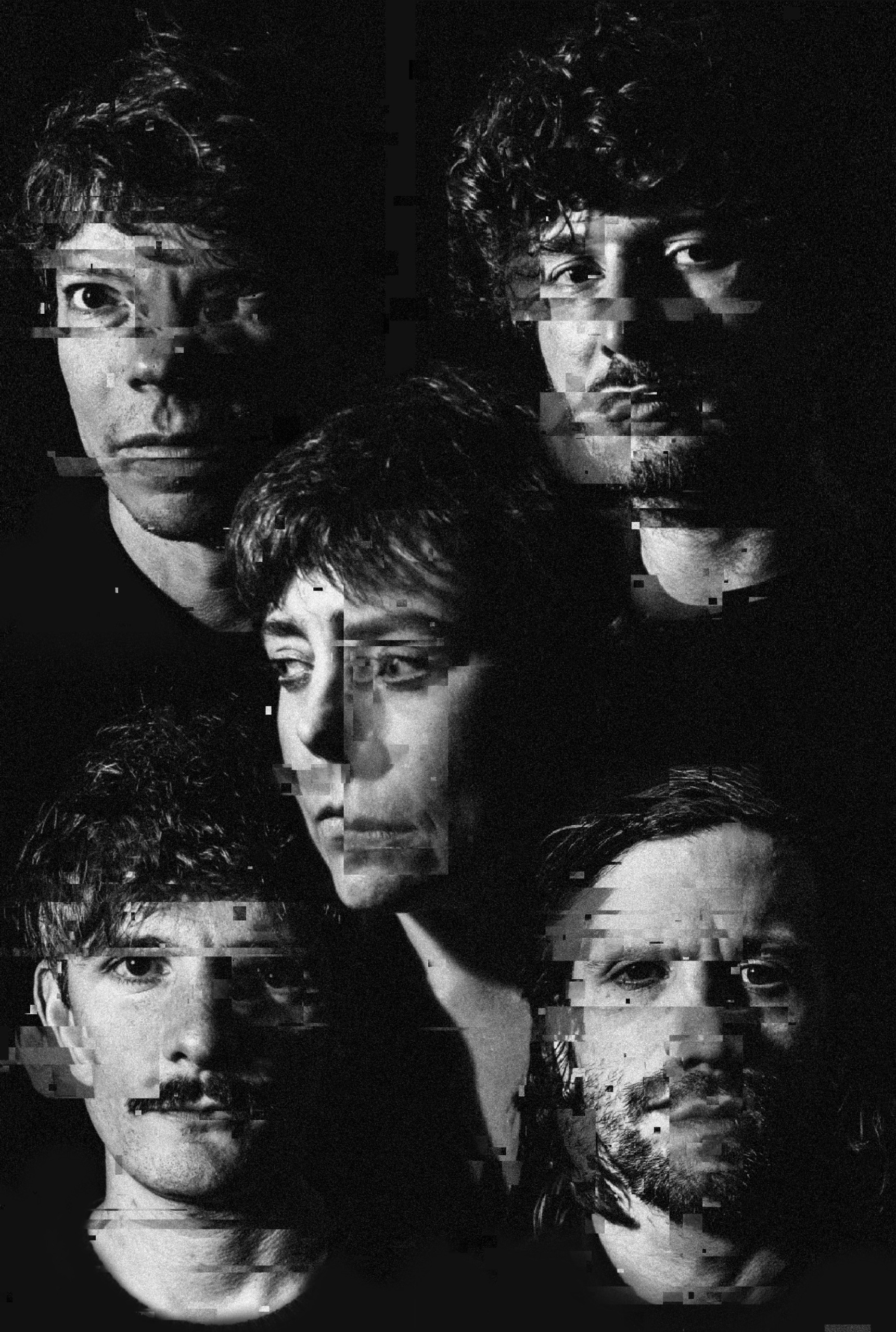
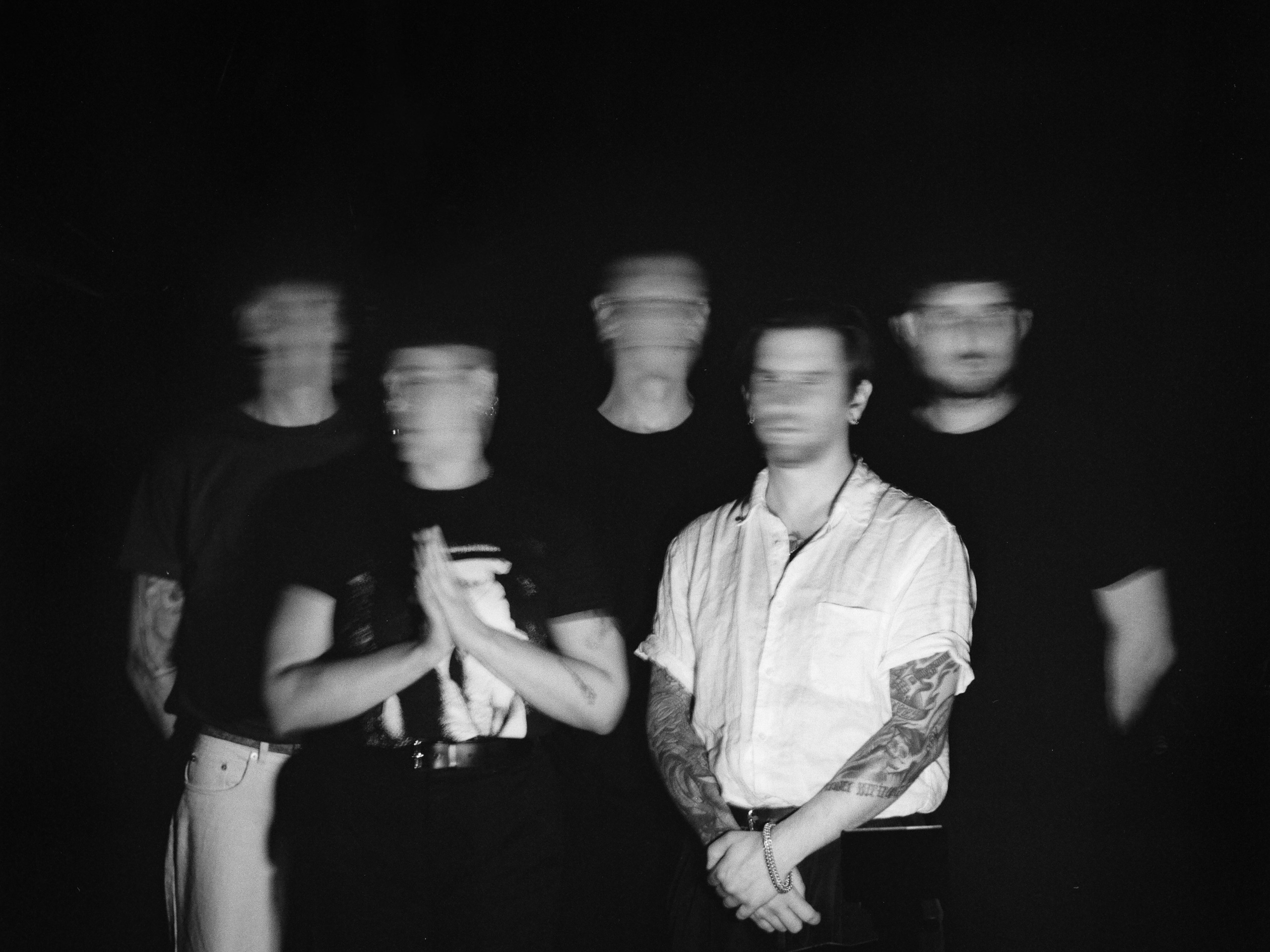
“Pain Magazine’s a great teacher of jumping into the deep end of the cold pool with both feet and learning that you fucking love to swim,” says Louisa Pillot, otherwise known as one-half of the industrial duo Louisahhh & Maelstrom. But this month, they’ve made a detour into uncharted waters. Pain Magazine are a collaboration between the duo and outspoken French post-hardcore outfit Birds in Row — and it happened almost by accident.
What was supposed to be a simple, one-off session turned into 16 days, and ultimately a full-length, Violent God. Off the bat, starting with its title track, the album unifies their two worlds with grace and precision — punctuated by layers of distorted guitars, each track hugs its own idiosyncratic, uneasy metallic heartbeat. Grating, whirring, there’s a tension that waxes and wanes across each song, hitting like a punk gut punch on “Magic,” where Pillot’s vocals evoke Poly Styrene’s taunting bellow. Tracks like “Weak and Predatory” march to a militaristic beat, drawing on the climactic darkwave landscape of NIN or Skinny Puppy. The slowest song, “Horse Song,” is heavily melodic, with the clearest vocals from Pillot and Birds in Row’s Quentin Sauvé’s haunting and rich harmony resulting in an anxiety-inducing, post-hardcore-meets-Cure masterpiece — brooding and heavy, it swells, building to a breakdown that never comes.
Read more: Every Nine Inch Nails album ranked
“For me, the fact that Pain Mag has always been free of expectations reminded me of how music should be lived,” Balboa says, of the instinctive, impromptu art. And this freedom, in its fabric, makes itself known. Violent God is surprising, and graciously spacious — allowing each instrument and its warped, unusual delivery to stand out, the many characters Pillot’s vocals play to properly introduce themselves, while its larger message unfolds. Though it doesn’t take long for the latter, as the album opens with a poignant political and personal cry, “Do I believe in a violent god? You make me believe.” And it’s a superb soundtrack for release, as much as it is tension — for the band as much as the audience, here is where we expel our angst over faith and violence, mourn a world on fire, reckon with the reality of modern society.
Mae Ferron
How did you all meet? What were the points of connection that led each of your projects to work together?
LOUISA PILLOT: Joris [Pain Magazine drummer/producer] had played a bunch of shows with us when we toured “Louisahhh Live Band” in 2021-2023, and we loved his incredible talent and great attitude, and he lives in the same city as Mael. Later, he helped Mael and me by lending us a ton of microphones and giving us really good feedback for our album Sustained Resistance. I think his notes helped shape the whole mix of the record, making it more three-dimensional.
We had wanted to do something with him already, when he suggested a collaboration with Birds in Row — they had just worked with Coilguns on an EP — and what initially was supposed to be a week making a song turned into 16 days making an album.
BART BALBOA: On our side, as Louisa said, we were into creating new things, via collaborations. Our last record, Gris Klein, was out for a couple years, but the work we put into it was actually about 3-4 years old. So we needed something new while letting this record live at the same time. We tend to take our time between each record because we like to come with fresh ideas and not just capitalize on what we think made our previous records (mildly) successful. The creation and release of this last record came with different tensions outside and within the band, so collaborations were also a way to get some fresh air and start over. After we worked on three songs with our friends in Coilguns, Joris came up with the idea of creating music with Louisa and Maël, whom we didn’t know personally, but artistically, it seemed exciting.
What are the biggest discrepancies between the post-hardcore and electronic-industrial sounds, and where are they similar? What about their ideologies?
PILLOT: Great question. I think sonically there is a lot that’s about building and releasing tension; there are different ways of doing that in terms of structure or dissonance or emotional intensity, but I think the lack of aversion to making something that’s really challenging to listen to, really grating and unnerving, is shared in both post-hardcore and electronic-industrial cultures and sounds. As for discrepancies, speaking for myself and Maelstrom, I think our focus and our forté is often in making “grid-based,” rhythmic pieces, whereas Birds in Row brought a lot more music — melodies, making songs with more than two notes — and this combining of skillsets and perspectives makes for a really interesting sound in Pain Magazine.
MAËL: Something else we share is this love for textures and timbres — in my solo work and in the music Louisa and I have made together, that’s always been the starting point. We’ve shaped the sound of our records by using machines or devices in ways they weren’t intended to be used, just to see what happens and get the creative process going. Sometimes that’s how we’ve stumbled upon harmonic content hiding inside a drum loop or some noise. This focus on the materiality of sounds is something BIR are exploring, too, especially with their latest LP Gris Klein, where it’s sometimes hard to tell if the music is coming from guitars, synths, or machines screaming into the void.
One of the main differences between our music cultures, I think, is how we approach improvisation. For us, coming from techno and industrial backgrounds, the record is a starting point where you collect ideas, and then onstage you start with these ideas and explore new directions. For post-hardcore bands — at least from what we’ve learned — the record is more like a score, and the live performance is expected to follow it. There’s still room for experimentation and improvisation, of course, but it happens within the boundaries of what’s been recorded.
Another difference is BIR’s focus on song structures, which is pretty new for me. I’ve been making hypnotic music my whole life, where the focus isn’t really on structure but on keeping people dancing — in trance, in hypnosis. As long as the main idea works, I’m usually not that interested in fine-tuning the details, and I quite like the idea of releasing unfinished music, since the purpose of techno tracks is to combine them with others. Joris from BIR, on the other hand, says he’s more interested in the last 10% of a song — finding ways to finalize the music so it reaches its full potential. So we had this way of working that was kind of complementary.
BALBOA: I think, all technical matters put aside, we create music for the same reasons. We need a channel to express things that would normally get us to blow up at people’s faces, so why not make it a show? I am not familiar with the techno/electro political background, but from all the conversations we had, it made it obvious that the different tones of our instruments didn’t reflect a gap in purposes. Different sounds, same ideas.
Working together, writing something that is so heavy and charged — was the writing process like?
PILLOT: We were working in a practice space that had two rooms next to each other, so Mael and I took one room, and Birds in Row took another, and we would shuffle back and forth with a thumb drive. By the time BIR had finished setting up their amps on day one, we popped over with the bones of “Violent God.” I think we have really opposite ways of working that end up being complementary; Mael and I are fast and driven by “mistakism,” where Birds in Row are much more technical, thoughtful, jam-based. We are all committed to the idea of process as
a thing that we value, as opposed to looking for a specific final product. As the days of building this record progressed, we got more comfortable with each other and started to have more ease in the back and forth and trying new things; the trust falls got more daring.
I remember feeling a lot of impostor syndrome going into the first session. I was so anxious about it that I threw my back out the day before. I really wanted to bring something to the table and was very impressed to be around such a talented group of “real musicians.” Everyone was so kind and open and had shared values politically and creatively that the work flowed quite easily. The songs started to create themselves beyond our divided lexicon of two separate groups and into a mysterious and wonderful third thing, thus Pain Magazine was born.
MAËL: We didn’t know each other that well before we started recording, so, like Louisa, I was a bit anxious. But we all walked in with no expectations and no pressure to produce anything. If we’d ended up with a couple of half-baked tracks, that would have been fine. We’d have left a little disappointed, but nothing more. That freed us up to explore without worrying about our egos, and I think that’s what made this record possible.
Louisa and I wrote a lot of new ideas pretty quickly, then we’d hand the stems over to Joris, Bart, and Quentin. Sometimes they’d only keep a loop, or just the vocal, or parts of a bassline that they’d reconstruct, Melodyne, and use to start a whole new track — “Hunter…” is one of those. Other times, they’d give us a drum loop they’d carefully tracked with multiple mics, mixed and processed, and we’d completely destroy it, pitch it down four times, turn it into something else entirely. That’s what happened with “Bastion,” for instance. Since we all agreed we were there to make something new, everyone stayed open and easygoing about their ideas getting discarded or torn apart. I think that’s why we wrote this album so fast and so easily — that, and Joris being an incredibly talented producer.
Were there any references that you shared while shaping what you wanted this project to sound and feel like?
PILLOT: Before going into the studio together, we started a shared Spotify (BOO, SPOTIFY!!!) playlist of references that was really all over the place. Some of the stuff you can hear as powerful influences throughout the record — Low, Nine Inch Nails, Portishead, Sonic Youth. Some of it was more of a subtle feeling or singular sound or moment that we wanted to pay homage to or use as a resource. Folks can check out the playlist here.
Jodie Roszak
Your music has so much depth and weight in its social statements, which is reflected so powerfully in the sonic approach — when was the first time you heard music (or first thing you heard) that made you realize the medium could stand for something more, that it transcended being just an art form?
PILLOT: Thanks for the kind words. I think we all have different entry points to that idea, that music is a platform and an important tool of liberation. For me, I think it’s actually a moving target; what started off in my teens as a “peak spiritual experience” as the result of collective effervescence and discovering the dance floor as a political space has shifted. It continues to evolve as our global situation becomes more dire and hope becomes a progressively more urgent discipline. I think that all of the members of our band share the stance that our work is to speak truth to power and to make the weirdos feel less alone and more empowered with the bold love that is required for real progress.
MAËL: I started my musical journey in the illegal rave and free party scene of the late 1990s. The first time I realized this was something more than just music was at an illegal festival on the site of a prospective nuclear plant, right next to the Loire River. There were trucks, buses, and vans circled around the biggest sound system I’d ever seen, with people improvising for hours on drum machines, synths, and samplers in front of it.
I remember thinking that this rave was opening up a kind of space where you could exist almost completely outside of everything that mattered in the society I’d grown up in — money, fame, success, social status, all of it. Everything was free. Every performer was anonymous. Even the records at the merch table didn’t have artist names on them, just stamps with logos or political slogans. But the music itself was free. There were no structures, no plan, nothing to help you anticipate what would happen. And it meant that somehow, I too could allow myself to become something that could not be anticipated or predicted.
BALBOA: As a very young kid, I remember my parents listening to early U2 records, and their statements about Sarajevo are probably the first time I saw music as something more than just enjoyable sounds. But I have to give 99% of the credit to the DIY punk scene that I embraced a bit before we started Birds in Row. Seeing bands, with speeches between songs, tour around the world without it being their jobs — and then experiencing it myself, touring, playing shows in squats, community-based spaces, where the intentions were always more important than the success — it really made me definitively cross the fence between meaning and entertainment.
What was the most difficult or challenging moment in making this album?
PILLOT: The music part was really kind of grotesquely easy, a very obvious gift with not a lot of struggle. However, because one of the main themes of this album is grief, I think that sentiment was being dealt with in different ways with each member, kind of unconsciously, and on many levels we didn’t even know about at the time. Whether it was on a personal, relational level, or mourning a dying planet or hopes for a different future, that feeling was pervasive, even if as a background noise, and I wouldn’t say that was a challenge so much as a fact that may have ultimately brought us closer together, in that we were all pretty vulnerable as a result.
Mae Ferron
What do you hope audiences or listeners experience from this?
PILLOT: Liberation.
BALBOA: I always hope the audience feels the same way that we do when we play our songs. It’s such a gift to be able to put your frustrations, pains, and hopes in between notes and words, only to understand what it all means several months later, that I hope people have the same experience that we have.
What does Pain Magazine do for you as an artist that your other projects might not?
PILLOT: For me, the element of surprise (we don’t know what we’re making, but it’s happening, and it’s working, and that’s very exciting), and the lack of expectations (let’s make a song, oh it’s an album, oh we’re a band, now we’re on tour, HEY!) is a really precious thing, and I really try not to take it for granted or try to game it out in a way that might be easier to slip into with other projects. Pain Magazine’s a great teacher of jumping into the deep end of the cold pool with both feet and learning that you fucking love to swim.
MAËL: It’s my first time in a band, which means I’m not controlling all the instruments at once anymore. I can just focus on one thing at a time, and that’s a completely different experience: I have to let go in order to make it work. There’s also something really joyful about making music with other people onstage, trying to show up as the best version of yourself for them.
BALBOA: I think the music industry breaks you, with stats and money and expectations of success, whatever the definition of it is. For me, the fact that Pain Mag has always been free of expectations reminded me of how music should be lived. I don’t want a label to tell me we need to be more visible on social media so records can be sold. I want to feel the intimate connection between me and my bandmates when we realize we created something together that we are all proud of, and then enjoy the fact that other people connect with it, too. And if they want to keep a record of it on wax, fine, but the truth of what we do is in the connections.