

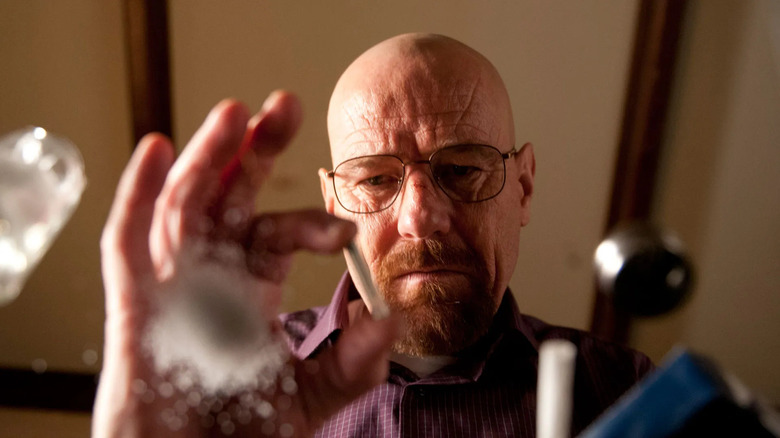
“Breaking Bad” made a name for itself with its high octane thrills and increasingly dramatic twists, but was the science fueling Walter White’s criminal empire scientifically accurate?
The short answer is: mostly! The long answer is that, with the input of science advisors like University of Oklahoma chemistry professor Dr. Donna Nelson, Gilligan and the writing team were able to use the real science of meth chemistry in order to create their unique world.
The centerpiece of “Breaking Bad” is Walter and Jesse’s meth cooking operation. And scientist Kate the Chemist points out how all the equipment and tools found in their lab are scientifically accurate, and the “old school” way they are going about cooking meth is all theoretically possible, albeit difficult to pull off considering just how much meth they are supposedly creating.
But not unlike Walter White himself, they weren’t afraid to bend the truth when it served their needs, creating more explosive set pieces than what would have been realistically possible. The result was one of the best TV dramas of the 2010s, if not the entire history of the medium, so clearly, the ends justified the means.
The meth cooking on Breaking Bad is accurate, but it’s no ‘how to guide’
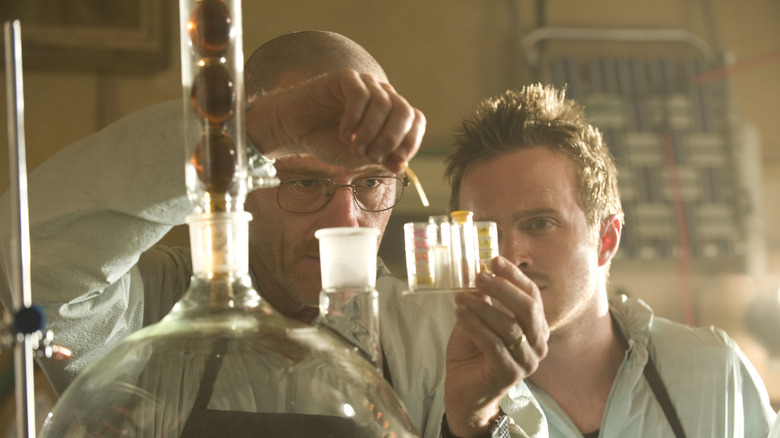
That said, while some of the actual techniques on display throughout the various meth cooking montages in “Breaking Bad” are accurate, the show was careful to never actually teach anyone how to cook meth. How to synthesize chemicals in a lab and distill them into new chemical properties? Sure. But how much pseudoephedrine (most commonly found in Sudafed) you need to start a new side hustle? “Breaking Bad” won’t give you the answer to that.
But while the meth cooking is more or less scientifically accurate, one aspect that is pure fiction is the blue coloring that becomes the show’s signature. While it is possible for Walt to use his chemistry prowess to create unusually pure methamphetamine, doing so would not affect the color of the end product. The only reason you would see different colors in a crystal, according to Dr. Jonathan Hare (via BBC), is when “impurities in minerals such as quartz crystal” are introduced that “can lead it to look pink (rose quartz) or violet (amethyst), but generally, the color is a result of the way the electrons in the substance absorb light and is not a specific indicator of purity.”
Walt’s immaculate product turning bright blue is pure fiction, designed to help his product stand out from the rest of the competition. And in order to bring it to life, the creative team found an elegant solution in simple blue rock candy.
Breaking Bad kept one foot in reality but wasn’t afraid to take dramatic leaps
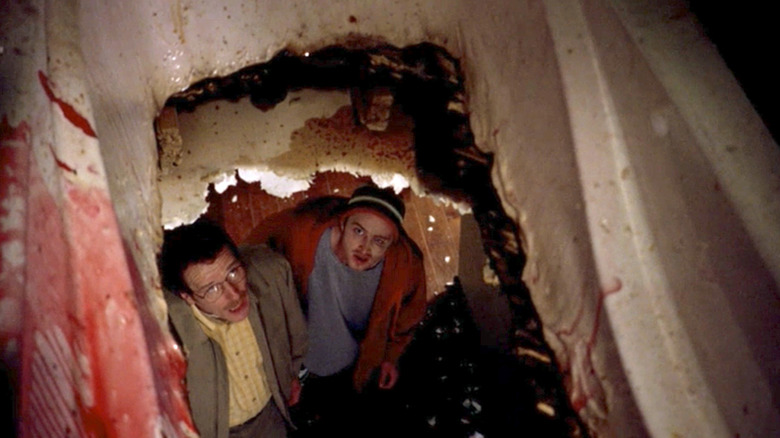
One of the show’s most dramatic (and traumatizing) moments happens in the first season, when Walt kills a gangster and leaves the job of disposing of the body to Jesse, using hydrofluoric acid that ends up eating through the bathtub and leaving a bloody mess to clean up.
In a special “Breaking Bad” episode of “Mythbusters,” they put this scene to the test and found that while the hydrofluoric acid did turn some pig parts into a horrifying slurry, it didn’t eat through the fiberglass bathtub at all, let alone the floor below it. So while hydrofluoric acid needs to be held in specialized plastic, there’s no such thing as a “super strong” version of the compound that can eat through floors like xenomorph blood.
Then there’s mercury fulminate, which Walt crafts as an impromptu explosive for his showdown with Tuco Salamanca. While Dr. Jonathan Hare calls this chemical “a very unstable and explosive compound that can only be safely made in very small crystals,” and Walt could reach Tuco’s office without blowing himself up on the drive over, the shockwave “would no doubt have detonated the other crystals in the bag on Tuco’s desk.” If they had “miraculously” survived that, Walt would have another problem in addition to his cancer: losing his hearing “for a long while.”
All these stories prove that, while “Breaking Bad” did take great steps to have one foot in reality, they never let it hold them back from telling a good story. Now is the chemistry of “Breaking Bad” more or less accurate than the legal escapades of “Better Call Saul,” the sequel series that some argue surpasses the original? That’s a subject for a different article.