Jul
5,
2026
If you happened to stroll down Melrose Avenue over the past few weeks, you may have stopped in your tracks at the sight of an American tank being crushed beneath a giant book. Or perhaps you spotted a reimagined American flag draped outside the Vista Theatre on Sunset Boulevard.
If you did, you witnessed the work of activist artist LAIKA 1954.
If you didn’t, don’t worry—that was part of the plan.
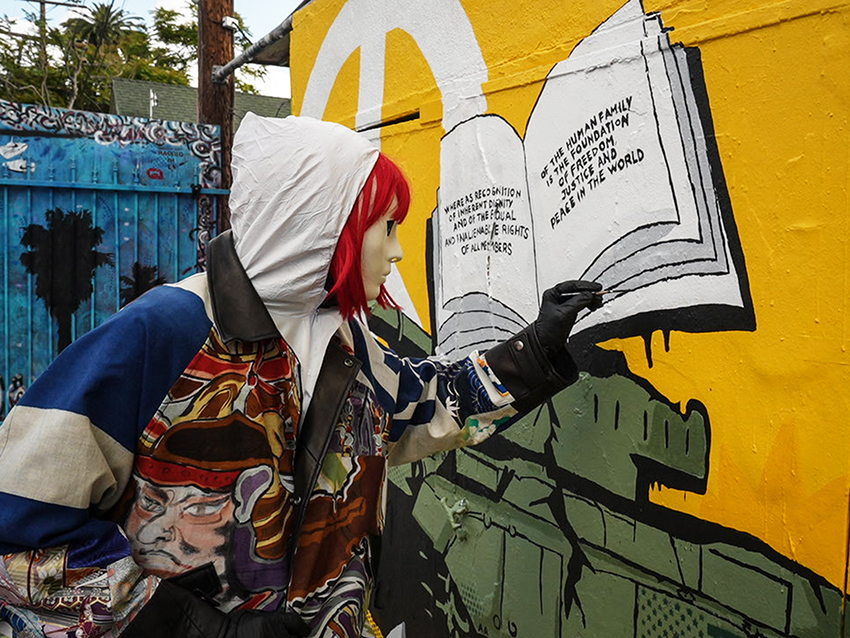
The anonymous European activist artist quietly spent several weeks transforming Los Angeles into an open-air gallery, installing nine unauthorized works across Los Angeles, Huntington Beach, and San Diego under the cover of darkness. Murals, paste-ups, installations, and illuminated signs appeared overnight in carefully chosen locations before disappearing just as quickly, leaving behind photographs, social media posts, and plenty of conversation.
Unlike traditional public art, LAIKA’s installations weren’t designed to last. Their temporary nature is central to the artist’s philosophy, forcing viewers to experience the work in the moment before it disappears.
Los Angeles has long served as a canvas for influential street artists. From Shepard Fairey’s iconic “OBEY” campaign, to Ruben Rojas’ “Live Through Love” philosophy, to WRDSMTH’s vintage typewriter, and iconic muralist Robert Vargas’ hand-paintings of cultural heroes, street art has shaped the city’s visual identity.
While Laika draws inspiration from Fairey’s “propaganda” model, the artist pushes it toward what LAIKA calls a “true political and social project.” The works are designed to create what one Italian art critic calls a “visual stumbling,” a sudden museum moment in the street, turning passersby into an audience they didn’t know they were becoming. Social media does the rest. Images that exist illegally for hours or days on a wall get documented, shared, and become effectively permanent.
One of the most striking pieces, There Is No Peace Without Human Rights, appeared in the Melrose Avenue arts district. The mural depicts the Universal Declaration of Human Rights crashing down onto an American military tank, creating an image that challenges viewers to consider the relationship between military power and humanitarian ideals.
Nearby on Fairfax Avenue, another work titled Jamás Tomarán Los Angeles portrays an ICE agent reaching unsuccessfully toward two angels—one Latino and one Black—carrying the Los Angeles city flag into the sky. Installed as immigration enforcement activity dominated headlines throughout Southern California, the piece resonated with many Angelenos already grappling with the real-world impact of heightened immigration raids.
Perhaps the most visually arresting installation appeared along La Cienega Boulevard in Baldwin Hills. Positioned directly in front of active oil rigs, five black barrels featuring hand-painted portraits of children spell out the words “NO WAR” when viewed from behind. The juxtaposition of industrial oil production with imagery of civilian victims creates one of the exhibition’s most haunting statements. LAIKA described it to us as a “visual and moral short circuit between the product and its human cost.”

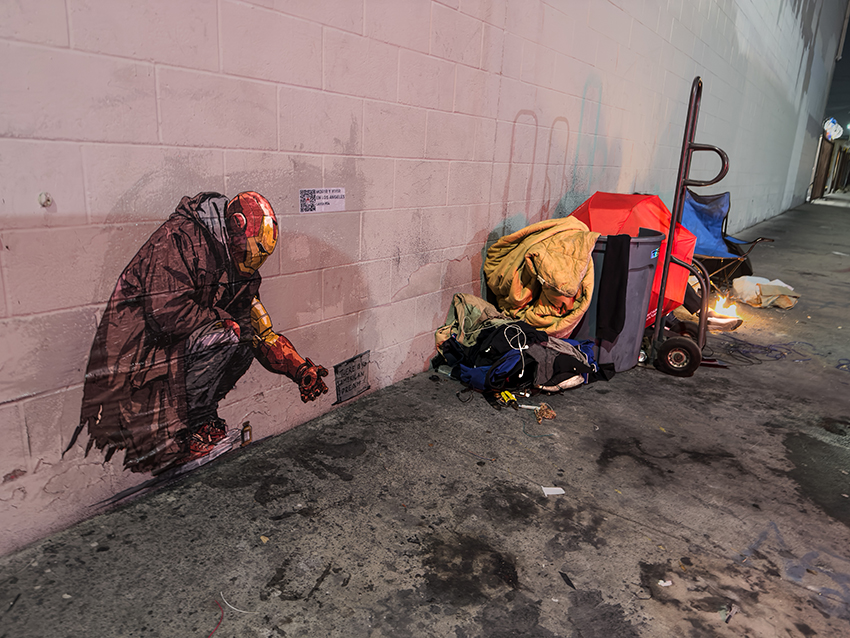
Downtown Los Angeles also became part of the project. There’s the one at Skid Row: an Iron Man (Marvel’s invincible billionaire) reduced to homelessness, crouched on a sidewalk with a bottle of fentanyl beside him and a cardboard sign that reads “There Is No American Dream.” LAIKA placed it at night, next to a real homeless person who had just lit a fire to keep warm. The image, pulled from a late-80s Marvel Gold comic title, has been circulating online since. The artist’s verdict on Skid Row, three years after a similar piece in San Francisco’s Tenderloin: “The situation only keeps getting worse.”
Two other works push even further. “There Is No Forgiveness,” a glowing image of Donald Trump kneeling before Pope Leo XIV, was installed at night in front of Saint Mary by the Sea Church in Huntington Beach, one of the few MAGA strongholds in California, specifically because that’s the audience LAIKA wanted to see it. And in San Diego, steps from the US-Mexico border, a poster quoting Hans Christian Andersen declared simply: The King Is Naked.
LAIKA keeps very strict anonymity, the mask, the artist explains, “eliminates all other filters.” It makes total freedom of movement and total freedom of speech possible at the same time. It also means the identity behind the work remains genuinely unknown, which keeps all attention where it belongs: on the images themselves.
If you missed the works in person, the documentation is online. The next chapter is already being planned says LAIKA, “I also know that I will have to come back many, many times…Hoping they don’t catch me first!”
The murals may be gone, but the conversation is just getting started.