Posted in: Comics, Heritage Sponsored | Tagged: bill everett, Carl Burgos, Comic Corporation of America, Lew Glanzman, Lloyd Jacquet, Tarpé Mills
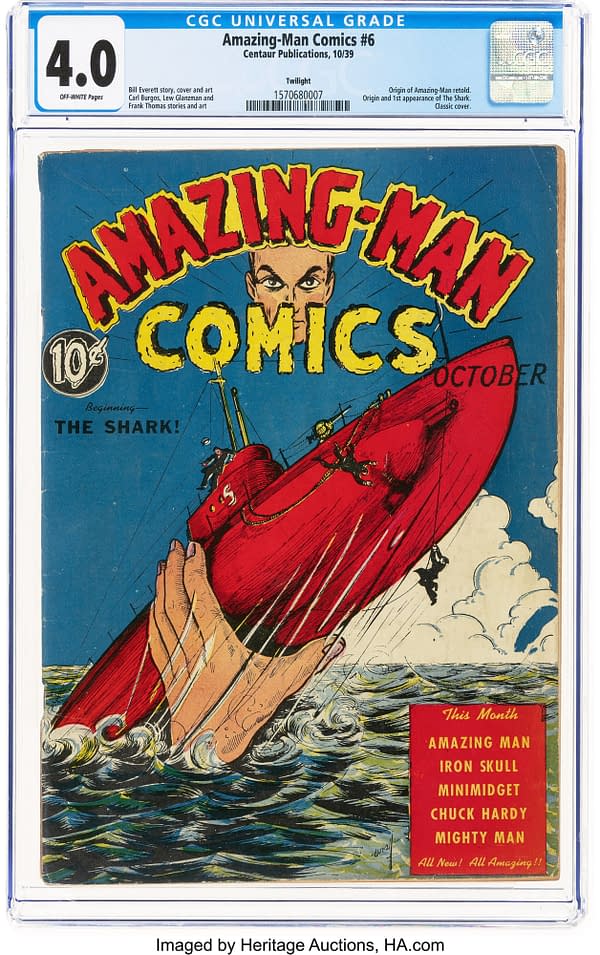
Amazing-Man Comics #6 features work by Carl Burgos and Bill Everett, and also includes an aquatic anti-hero called the Shark, king of all sea life.
Article Summary
- Amazing-Man Comics #6 is the second issue of a key 1939 Centaur title, launched with the unusual numbering after #5.
- Bill Everett’s Amazing-Man story ties the hero to wartime anxiety, with roots in Lloyd Jacquet’s push for a Superman rival.
- The issue features the debut of Lew Glanzman’s Shark, an anti-war sea champion shaped by 1930s merchants of death fears.
- Tarpé Mills and Carl Burgos add giant ivy disaster and Iron Skull android action to Amazing-Man Comics #6.
Amazing-Man Comics #6 is only the second issue of this important and highly collected early Golden Age title. Comic Corporation of America started the series with #5, and there were no issues #1-4. The reason for starting with that issue remains uncertain, though there are theories, and the numbering does make it easier to underestimate this issue. Bill Everett puts Amazing-Man’s in the middle of a historic war-era controversy, Lew Glanzman introduces the Shark, Carl Burgos continues The Iron Skull, and Tarpé Mills transforms real newspaper headlines into science gone horribly wrong. Hitting newsstands around September 14, 1939, thirteen days after Germany invaded Poland, Amazing-Man Comics #6 is part of that historically terrible second half of 1939, which also saw the comic book industry start to scale up as the Golden Age of comics took shape. Art director/editor Lloyd Jacquet would oversee the contents of both Amazing-Man Comics #6 and Marvel Comics #1. Those two comics hit the newsstands a couple of weeks apart, and they share more than a little DNA.
Bill Everett uses the first page of the lead story to bring readers up to speed on Amazing Man’s origin. Chosen as an orphan by the Council of Seven in Tibet, he was trained in strength, knowledge, courage, and the other qualities needed to become an extraordinary man. The chemist Nika gave him the ability to vanish in a cloud of green vapor, while the Great Question plotted to control his destiny. In 2009, a remarkable family letter surfaced on eBay, offering some insight into its origin. On March 1, 1939, Everett’s mother Grace wrote that Centaur editor Lloyd Jacquet wanted Bill to produce a new strip to compete with Superman. She planned to spend a day at the public library researching old and foreign folk tales for her son. The letter does not name Amazing-Man, but the timing and context make it clear.
The Shark Takes On the Merchants of Death
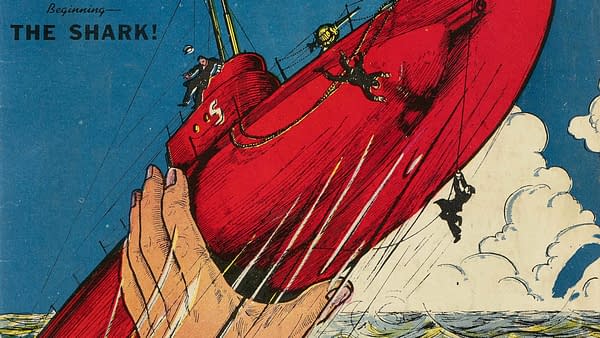
Everett drew the cover for the debut of the Shark, while the six-page story inside was by Lew Glanzman. The new hero has webbed hands and feet, the strength of ten whales, the swimming speed of a whale, command over sea life, a secret underwater castle, and the ability to project a hypnotic image of himself. His debut saga in this issue is surprisingly grounded in the history of its era. A gang has destroyed five ships belonging to the fictional country of Furvainia and made the attacks look American. Once Furvainia declares war on the United States, the villains behind the gang expects to make a fortune through what one conspirator calls “that ammunition plant” by selling weapons to both sides.
That scheme appears to have been inspired by one of the most heated American political controversies of the decade. The Senate Munitions Committee spent 1934-1936 investigating claims that arms manufacturers and financiers had helped draw the United States into World War I for profit. According to the Senate Historical Office, the committee found little hard evidence of an active conspiracy, but its hearings strengthened popular suspicion of the “merchants of death” and helped inspire the Neutrality Acts. Seventeen-year-old Lew Glanzman was still near the beginning of his career, and the Shark became one of his best remembered Centaur features. He would later paint more than 80 covers for Time, and illustrate historical moments for National Geographic.
“The Ivy Menace” by Tarpé Mills may have been inspired by breakthroughs in plant growth hormones that were making newspaper headlines in January 1939. Professor Philip Hampton is trying to solve a social problem by developing a formula to grow giant crops on as little land as possible. A cat knocks the bottle onto ivy, and within minutes the plant demolishes Hampton’s New Jersey mansion. It spreads across the countryside, covers highways, reaches New York, sends more than a million people toward Grand Central Station, produces runs on banks, and drags down skyscrapers. This story appeared two years before Mills launched the newspaper strip that made her famous, Miss Fury.
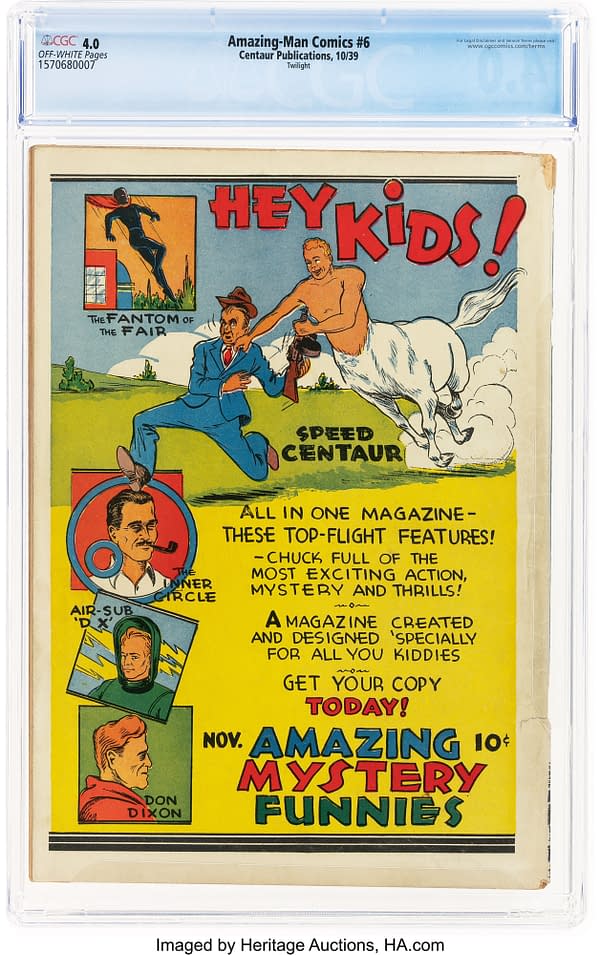
Amazing-Man Comics #6 combines Bill Everett superheroics, the debut of Lew Glanzman’s anti-war Shark, more android mayhem from Carl Burgos, and a Tarpé Mills nightmare built from cutting-edge plant science. Heritage says it has offered only two higher-graded copies ever, and none higher since 2014. For collectors interested in a deceptively early Centaur issue that shares plenty of 1939 Marvel DNA, there’s an Amazing-Man Comics #6 (#2) Twilight Pedigree (Centaur, 1939) CGC VG 4.0 Off-white pages up for auction at the 2026 August 13 Golden Age Century Comics Showcase Auction V #40377.

Affiliates of Bleeding Cool buy from and/or consign to Heritage Auctions.
Enjoyed this? Please share on social media!



Stay up-to-date and support the site by following Bleeding Cool on Google News today!