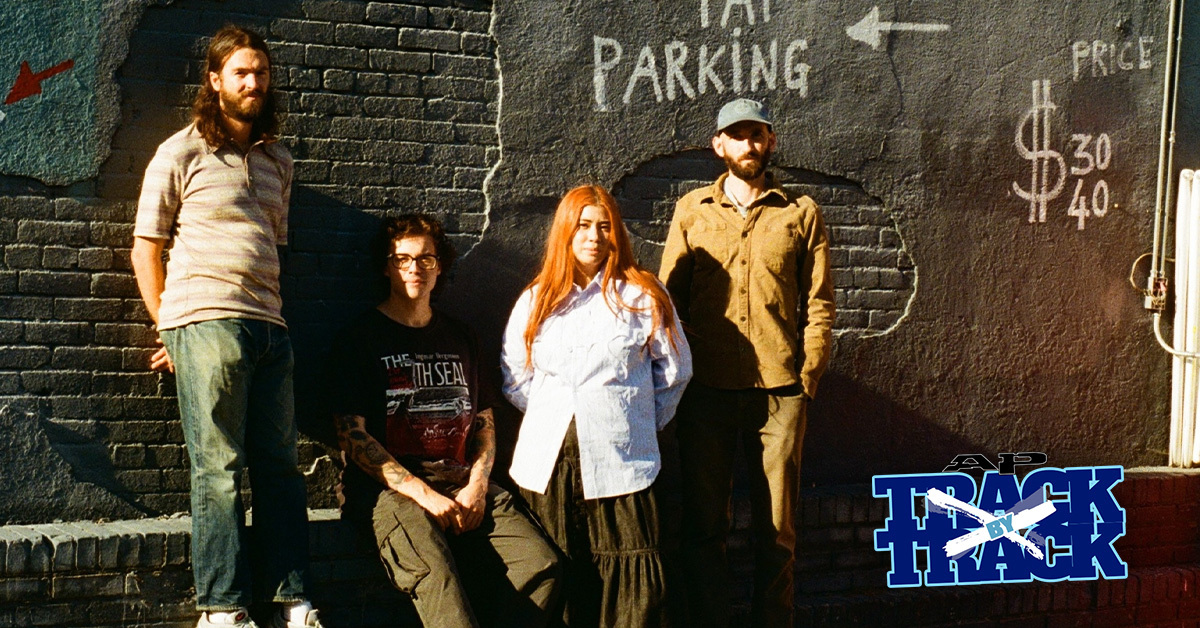
“There’s always a consistent push toward progress,” Glitterer bandleader Ned Russin says, reflecting on the making of “Not Forever” from their new album, erer. “It’s not something I subscribe to, but something I’m constantly faced with. We have to work actively toward the things we want to change — they won’t just change because they’re supposed to. I don’t mean that pessimistically, either, because honestly, I find it to be a very hopeful idea: We are in charge of our own futures, and we can make them better should we so choose.”
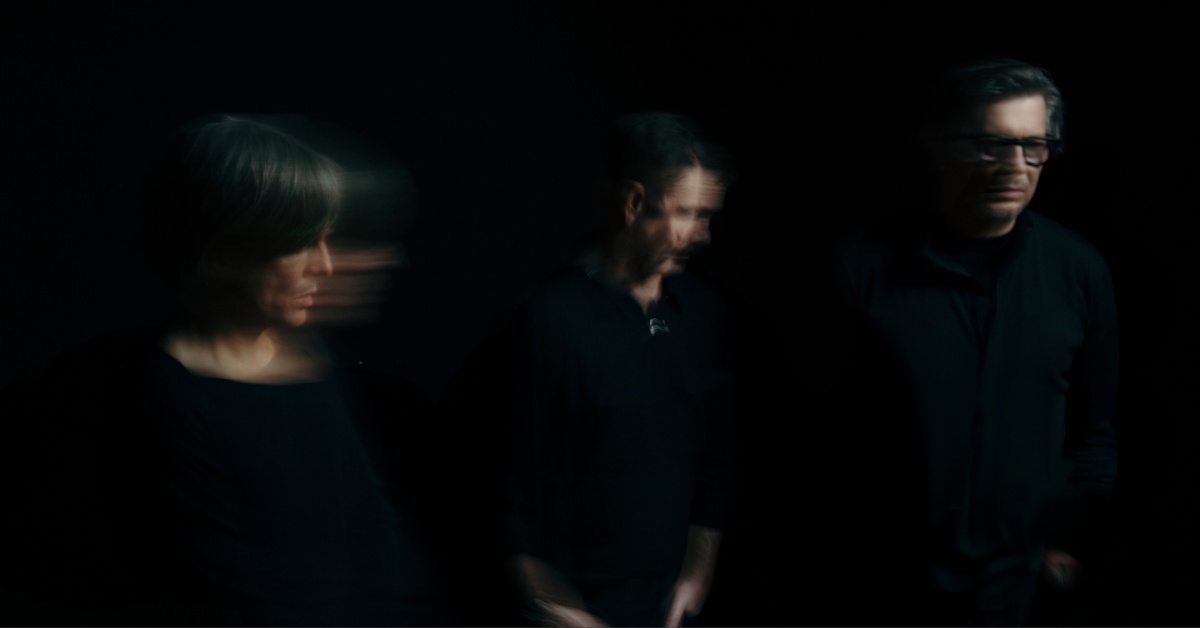
It’s also a statement that defines the spirit of Glitterer, which expanded from a solo project into a full band — currently rounded out by keyboardist Nicole Dao, guitarist Colin Gorman, and drummer Robin Zeijlon — for last year’s Rationale. Russin spent much of his Title Fight days being “terrified of growing up,” but the work that permeates Glitterer, and erer as a whole, seems to reckon with change, clarity, and hope in ways that are profoundly moving. “Stainless Steel” tries to combat the exhausting state of the world; “New Mattress” contends with consumerism; “Self Sufficient Bliss for All Eternity,” whose title comes from Philip Roth’s American Pastoral, addresses a desire to feel brand new. Released on the band’s own Purple Circle Records, Russin calls erer an “anti-individualistic” album, holding collaboration with his bandmates in high esteem. When he takes us through the album, track by track, he opens up about the many ways that he couldn’t have made erer alone.
Read more: Behind Touché Amoré’s intimate Spiral in a Straight Line documentary
Glitterer will embark on a headlining tour in 2026 with Prize Horse and Graham Hunt, as well as stop by Coachella, Something In The Way, and Outbreak. See the full routing here and a breakdown of erer below.
“Somebody”
Historically, Glitterer is not a tinkering band. We usually try to get ideas down and solidified quickly so that we can move on to another idea. “Somebody” was one of the earlier songs we began working on, and while its shape remained largely intact, we edited this song probably the most of any on the album. Robin came up with the idea to introduce the chorus in the middle of the first verse, which is honestly something I don’t think I’ve ever done before. While the song always had some of my favorite parts, it took a while to click, and when we finally got it together, it seemed pretty obvious to me that it would be a great opener, a pretty sacred spot on any record. The song deals with self-reflection, wondering if protecting something you care about is more about caring for yourself in the end.
“Stainless Steel”
This was the last song that was written for the record. I actually took the day off from work with the intention of working on a new song. I had an idea that I began working on the day before, and after setting up my modest demo rig, the whole song kind of came together pretty quickly. I realized after I had the skeleton of an arrangement together that the chords for the chorus were actually something I had from a few years ago. I rarely reuse parts. But for some reason, I couldn’t figure out a way to finish it before, and this time, with the new ideas around it, it clicked. The vocals for the chorus came next, and I initially wrote what became the harmony. I stumbled on the main melody after, and then shortly after I had that together, I got a call from a friend to come and help him move a couch. He lives about a 10-minute walk from me, so I put the song on my phone and put it on repeat while I walked there. I moved the couch, and then repeated the process for the walk home. Shortly after that, I had lyrics for the rest of the song. The trope of the complete song pouring out is tough because sometimes it is true, but it’s usually exaggerated at least somewhat. I’d say it’s rarely five minutes, but before lunch, I had a fully fleshed-out song. Also, as a quick note, the knocking at the end of the song was Arthur [Rizk]’s idea. He wanted to record authentic knocking, so he locked Robin out of the live room and set up a mic on the door and just let it record until Robin tried to come back in.
“Until”
We played a show at a venue in D.C. called 618 in May and had an entire weekend-long practice after it. We went between two practice spaces, as our first option became unusable after a group of middle-aged men started playing blues rock very loud while we were quietly talking about the ideas. So we went to the basement of a record store instead and started working again. By the end of the weekend, we were pretty burnt out. We had spent three entire days attempting to come up with new ideas, and by the end, it seemed like they had stopped flowing. I pulled out my phone and was going through old Voice Memos in the final stretch, and came across this simple idea. “What if this was just the entire song?” we thought. That night after throwing it together quickly, we recorded a demo of the song. In the second verse, Colin’s chorus and distortion pedals interacted in this strange way and sounded like a siren. When we went to Arthur’s, he loved that part of the demo and put it under the actual recording. You can even hear the demo vocals faintly in the background. The lyrics, like the lyrics to “Who Owns This Mountain?,” are facetious, showing their hands as the song continues.
“Remind Me”
This might be the most individualistic song on an anti-individualistic record. It was one of the earliest things we wrote for the record, and the lyrics came quickly out of a moment of anger and confusion. At this point in my life, I don’t hold on to those feelings like I did when I was young, but in the moment, I still feel the need to correct a misguided account, which is how I ended up with the verses. I think the chorus walks it back. I often find myself doing that, contradicting myself between two different parts of a song. Oftentimes, it’s not intentional — we just always seem to hold these conflicting thoughts.
“Not Forever”
The first part that was written for this one was the very end. I was at my parents’ in Pennsylvania and had my bass with me for some reason, and in just a quick moment, both the chord and the riff came to me. I couldn’t capture it accurately, so I went upstairs and recorded the song on my family’s piano. I uploaded the part to our shared note, and seemingly at the next practice, the song was finished. I wrote most of my lyrics sitting at home, singing quietly to myself down an octave, and when I wrote the last part, I knew it had to be sung with a certain amount of intensity. I wasn’t sure how high it would be in my register, and when we first played the song in full, it felt like it was met with immediate approval from everyone, even if my head was spinning.
“Who Owns This Mountain?”
As its name implies, the Wyoming Valley, where I grew up, is surrounded by small mountains. There’s this one stretch of highway between Kingston and Dallas, Pennsylvania, the one right where the infamous Troph tag on the highway sign was in our youth, that goes right beside a mountainous stretch, and one night as I was doing this drive, I noticed a house on the hill standing there all by itself, solitary and all lit up. I took my phone out and wrote “who owns this mountain,” a refutation of the ludicrous idea that someone could own that, or any, stretch of property, as if nature is ours to be conquered. Later, after enduring an argument about differing views on a singular event, it occurred to me that there are many similarities between our inability to come to terms with either of these truths, that we can’t recognize our perspectives are filled with bias and inaccuracies, just as must as we can’t let go of this idea that land is not ours to own.
“Incremental”
One day earlier in the year, we had scheduled a practice in Pennsylvania. Unfortunately, some inclement weather hit that weekend, and last minute, we opted out. I spent that night at home and just wrote this song in one sitting instead. It remained largely the same when the whole band came in. The biggest change was that we actually slowed it down quite a bit. Because I started this song later in the day and demoed it at home, I recorded the vocals at night and didn’t want to disturb my neighbors. I assumed I’d sing it up the octave, but the lower register stuck. It is by far the lowest note I’ve ever sung, and is, I think, the lowest note I’m capable of singing.
“Victory Lap”
Every Glitterer record up until Rationale featured at least one instrumental song. When the band started, I was very self-conscious about being the only singer for some reason and wanted to give listeners, and myself, a break from my voice. This one came at the very end of the previously mentioned May weekend jam, written in the same final spurt as “Until.” Nicole’s key part was so simple but really solidified everything, and the song felt complete even if it was only one part. Pretty early on, I pushed for this to be an instrumental, seeing as it was unique in its tone, as well as wanting to return to earlier formatting decisions. We really only had the first part up until the weekend before recording. We spent three days in Wilkes-Barre practicing in our practice space up there, and Colin came in on the first day with this new second part. I’ve known Colin since I was 15 years old, and this part, to me, is so immediately Colin, which is why I love it.
“New Mattress”
The title of this one and the lyric in the song were actually taken from the working title. I wrote the main part of this song while waiting for a mattress delivery, hence “New Mattress.” I’ve had a newer fascination with consumeristic tendencies and personal responsibilities lately. The lyrics didn’t begin that way, but somehow, with a few tweaks after the first draft, it became a song that directly dealt with that. And now, it seems to make a lot of sense that way.
“Self Sufficient Bliss for All Eternity”
We had a practice toward the end of writing that only Robin and I could make. We decided to try to just throw out some new ideas to see if we could come up with some last-minute ideas. This song started there, and I think originally I envisioned some guitars coming in at some point. We demoed it without anyone else, and then once we sent it to Arthur, he really insisted that it stay as it is. When we got into the studio, we stripped it back even further. Arthur really insisted that this song be moved up in the order, but told us we could keep it at the end if we make it a music video of it, so we will have to do that soon. The title is taken from Philip Roth’s American Pastoral, which I was rereading while we were recording, in a description of Jainism.