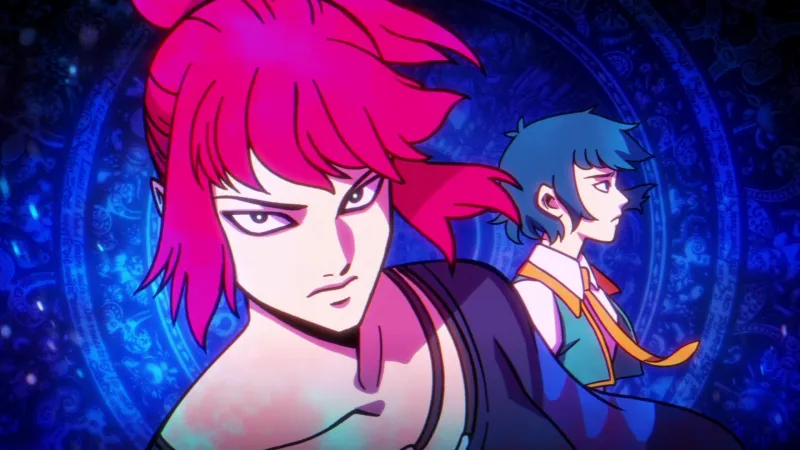
After experiencing a tremendous loss, some try to stay grounded in their community, while others turn to the stars for answers about life’s grand design. In Walt Disney Animation Studios’ artistic director Malcon Pierce’s Oscar-qualifying short Versa, a pair of celestial lovers try to work together to pull themselves out of a black hole of despair after the loss of their baby in the last stage of pregnancy. Though the six-minute short has no dialogue, it has plenty to say through dazzling animation, a beautiful score, and by moving the nameless male and female couple through the galaxy with nothing but expressions that run the gamut from joy to loss, grief and acceptance.
Below, Pierce talks to Deadline about the inspirations behind the short, his own journey with loss and expanding the boundaries of complex storytelling at Disney.
DEADLINE: Where did the idea of Versa come from?
MALCON PIERCE: I went stargazing 15 or 20 years ago with a friend of [me and my wife], and he showed us a bunch of things. We looked at two stars, called the Albireo star system. It’s two blue and yellow stars that orbit each other. At the time, I was interested in performing arts and how we can use them in film. Thinking about dance and movement, I wanted to do something with it at Disney, so I worked on a lot of ideas and got excited about some, but ultimately, the idea fell through because I felt it wasn’t the right story yet.
So, I was on a treasure hunt for the right story to use about the idea of stars, and it slowly faded away over time, but it was somewhere in my subconscious. Then, during the production of Moana (2016), my wife and I were expecting our son, Cooper, but we had some complications during the pregnancy, and he ultimately ended up passing away. And this reset my wife and I in a very big way. I was just thinking about grief as this incredibly big and nearly impossible thing to get over.
DEADLINE: How did you manage to push through that to make Versa?
PIERCE: Ultimately, it was my wife who ended up shining a light on how I was dealing with the situation. Her method of dealing with grief was by living it and facing what had happened, and she would always talk about, “I wonder what Cooper would’ve looked like,” Or “Man, remember when we went here and did this and that?” I found it very scary, so I was doing the opposite, where I just tried to keep myself distracted, and I was like, “I’m not going into the nursery. I don’t think I’m ready.” It was this idea that if I shut out this loss, I’d get better, and when I’m better, I’ll be able to talk about it. My wife is a photographer, and she said to me, “I feel like it’s important that we capture the moment.” And so, she took pictures of herself in the nursery with the crib, his clothes, and some other stuff we had gotten for him. She found comfort in continuing to have a relationship with Cooper this way. Then it was my turn, but I couldn’t go inside the nursery. So, I’m standing outside in the doorway, and she takes a picture. Then she said that both of us should go in there. And, I was so resistant to it, but she told me, “This is important, you need to do it. It’s going to be OK, because I’ll be there with you.” So, I went in.
What I expected to happen when I entered the nursery happened. I felt like I got split open. Everything was just so heavy; I never made sounds like that before. My wife took a picture of that moment. Then afterwards, we had this picture of the two of us in there, and later on, I was looking at these photos, and it was such a turning point in my experience with this story.
I realized in this picture she took of us, my wife had this star pendant that a friend of ours made – and on top of that, she started a non-profit for foster children named Cooper’s Totes – and she was smiling in the nursery. And in hindsight, Cooper’s [theme] was “Twinkle, Twinkle, Little Star,” and everything we had for him was star-themed and star-related. At the end of Moana, we found out that we were pregnant with [current child] Casper. And when you have a child after the loss of another, the terminology is “rainbow baby.” So, we had this baby, and there was an incredible feeling about the circle of life, for lack of a better phrase.
We also had this star gifted to us by my mother-in-law, and it was a little crystal candle holder that we’d put in our kitchen window, and every morning we would come down, and the sun would hit it in the morning, and it would make rainbows and shoot all over the house. And that became a way for us to say, “Hey, there’s Cooper.” Then, at the end of Moana, I asked John Musker and Ron Clements if we could put a little star next to Cooper’s name in the credits, and they agreed. So, after that, everything started to come back around to this idea that I had learned so much from this experience and felt a need to continue to share that experience, and decided that maybe that’s the story for this high star concept that I had in my head for so long. So that was the genesis of everything, and then the thematic story came together, and we were off to the races.
DEADLINE: Disney’s never done a story about pregnancy mishaps or pregnancy in general. How did you pitch this? Was there any fear?
PIERCE: Well, I was inspired by the infant loss groups that my wife and I would go to. There were a lot of people talking about how they were triggered by watching movies featuring pregnant characters. And there was a lot of conversation about grief within couples who deal with the situation differently – either one of you wants to talk about the issue, or you don’t. So, I eventually saw that this is something a lot of couples go through, and wouldn’t it be cool to have something that can reflect an experience like that and maybe help them relate to one another? I vividly remember a moment in the hospital when I literally thought, “I don’t think I’m ever going to laugh again.” And looking back on that, I was thinking how intense that feeling and thought were. So again, it came back to how I can make something for this community in infant loss and miscarriages. It’s hard to talk about, but it can be impactful.
In terms of pitching, I just made it up as I went and put my trust in Jennifer Lee [former Walt Disney Animation CCO]. I was an animation supervisor on Frozen, and through that project, I got to know her well, and I admired how personal she was with her storytelling – she was so vulnerable. I just sent her an email and shared the idea; she was receptive and told me to do it. We put together a slideshow of ideas on how it would look, kind of like elements of Fantasia with musicality, since I’ve always loved performing arts. She then referred me to Paul [A.] Felix, the production designer, because he loves astrology, and that’s the feel I was looking for. So, I shared the idea with him, and I got a little more confident and comfortable with what I was doing. A couple of years later, I shared another update with Jen, including my outline and everything, and during the meeting, she told me she was impressed with the project’s growth and how much easier it was for me to talk about it. This project was a great therapeutic thing, and I’m so glad people helped me along the way.
My favorite part of all this so far is that we recently played the short at the Ottawa International Animation Film Festival, and there was a meet-and-greet afterward, and a man showed me a picture of his rainbow baby. And I was like, “Oh my God, this is exactly what I wanted for this.” There were so many other people coming up to us, saying that their friends or family members had experienced something similar. It was touching and heartbreaking to see people come together because of this short film. Grief is so hard, and the short touches on this.

Versa
Walt Disney Animation
DEADLINE: The animation is stunning. What was the inspiration there?
PIERCE: It was so tricky. Part of the pitch was essentially me telling people I wanted to do a non-verbal choreographed dance in space about infant loss. I didn’t want it to be too high concept, where the overall narrative doesn’t land. Early on in my head, I was thinking about the stars and what if it was the beginning of a nebula or something? So, the challenge was: how do I take these two characters and use as few elements as possible in the short?
There was a version where I had a full kid’s room with cloud toys and everything, and I really wanted it to feel a little bit less literal in some ways. And so, we really felt like we needed a few iconic elements that would be very symbolic. And so, the bassinet was a thing where I was like, “I really need to make sure that there’s a bassinet, and I think that’s going to say all we need.”
The nebula is the nursery, and that’s the cosmic throughline that’s always been inspiring and fun to try to connect [all these different thematics to]. So, we created this wonderful nebula with Ryan Lang, our production designer. Also, there’s a moment when the dad brings in a planet-like mobile, and it’s a surprise for the mom. So, we spent a lot of time thinking about how literal versus how simplistic we can go, and really just trying to make it feel like this cloud-like, fluffy crib. But that was the challenge: how minimal can we go? Because it’s easy to add stuff but really challenging to remove things, the lack of dialogue made it that much harder. I also didn’t want to add more characters. There was a moment when we considered adding other characters for people to see, but we tried to keep it all focused.
DEADLINE: What about the choreography? They float around like ice skaters.
PIERCE: I just love animation and how expressive it is. Dance also just feels raw and emotional, so this was a powerful way to express the performances in the short. I was looking at a lot of dances, from modern to ballet, and they were all very beautiful, but I felt something wasn’t quite landing in the world we were building. I didn’t want them to be totally weightless and flying around. We asked ourselves what choreography makes sense for the idea we had. Through that, we discovered ice dance, which is dancing on ice skates – not quite like figure skating. When you’re skating, you can be moving very fast, so you have this ability to have these kinetic, lyrical movements for these characters, but also be very controlled and simple in the performance. I also thought about that moment with the fairies who dance across the water in Fantasia 2000. So, we worked with ice skaters and choreographers Katherine Hill, Jordan Cowan and Ben Agosto to help animate the mom and dad’s movements. I would do storyboards, and they would do a version of [what was drawn], and we’d meet on Zoom to give feedback and notes to each other.
Our vocabulary was one of the interesting things about the collaboration. For example, to say, “Screen space left to right” isn’t a thing on the ice. They’re performing at all aspects of the ice rink, so there are moments where I’m like, I need to make sure that screen right is healing for mom, but bad for dad. Screen left is bad for mom, but good for dad because he’s avoiding the situation. It was fun having that.
DEADLINE: Why the color choice of red and blue for the two parents? And then the gold cracks, which look similar to the Japanese art of Kintsugi.
PIERCE: At the time, I was conceptualizing the mom as this peachy color, and the dad was a purpley color, and I was like, “This is looking great,” and we had already started our character team on making the designs. So, one day, I showed my wife, who I call my spiritual executive producer, the characters and I asked her what she thought, and she goes, “Why am I peach? I’d be blue. I’m moody and tuned into my emotions. I’m blue.” So then, I was like “Oh no.” [laughs]. I got a hold of the producer, Brad Simonsen, who is amazing and got this project across the finish line, to tell him to change the color of the characters [laugh].
And yes, we did use the Japanese pottery technique of Kintsugi because I always knew I wanted a transformation between these two characters. So, sort of in line with a Beauty and the Beast-esque transformation, I wanted to do another classic Disney-inspired transformation geared towards rebirth. I remember pitching Jen the idea of the characters going through the loss of their child, only to fully transform into a bigger, better version of themselves. I always wanted them to fall apart to where only their stars are left [after their bodies are disintegrated]. The stars are their soul, and then they come back together. So, it became about how do we earn that new version of those characters?
Chris Buck suggested that I read a book called Permission to Mourn [Tom Zuba], and there’s a line in there that says, “Grief has a way of splitting you open.” And I was like, that’s the way to earn this moment. Mom and dad get split apart. And that was relatable to my own experience in a lot of ways. I had this idea that you could have a great loss and go through the steps of grief, and then you could start the next chapter. But that’s not true. What we learned is that grief is something that you learn to have a relationship with and you carry it with you. Over time, it becomes easier to carry, but it can also be very heavy, so I wanted to show this idea of wearing your scars proudly.
Right after we lost our son, I was coming to work, I didn’t want to talk about it and was hiding all these scars. Then, after working through understanding and the power of acceptance, I started to look at it like, I still have a relationship with Cooper. It’s different than what I expected, but I think about him all the time, and he’s with me all the time. So, Liz Watson, our creative executive on the project, just so happened to ask me about Kintsugi, and I hadn’t at the time. And as soon as I googled, I realized that the symbolism I needed was to show that the two characters are visually different but not completely new versions of themselves. It was the intention that you broke apart, but you’re back together, and because you’re stronger now, you can wear these scars, and they’re beautiful and these experiences we go through in this life matter. So that tied a nice bow on the transformation and colors.
[This interview has been edited for length and clarity]