Some great screenplays are immediately acclaimed. Others slip through the cracks, especially when it comes to the Oscars. The Academy frequently bypasses inventive, boundary-pushing scripts in favor of safer, more conventional fare. With this in mind, this list looks at some of the very best screenplays that never received an Oscar nod.
The scripts below cover a wide array of genres and tones, but all are terrific. They run the gamut from the tightly wound paranoia of a whodunit to the poetic melancholy of an intimate romance, philosophically charged sci-fi to pitch-black comedy.
10
‘The Lighthouse’ (2019)
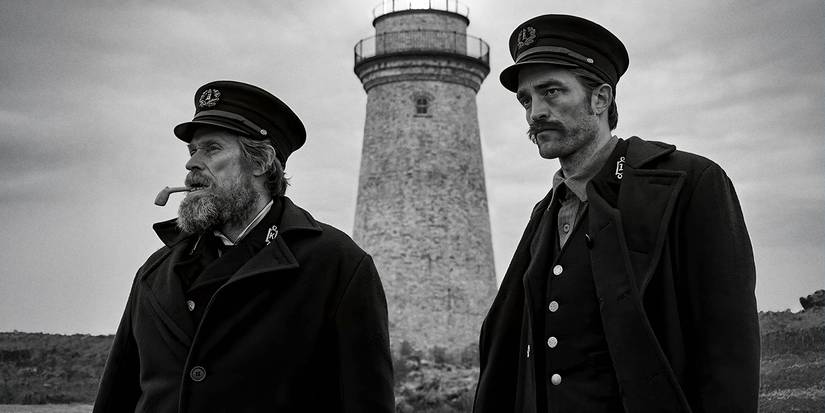
“Yer fond of me lobster, ain’t ye?” With The Lighthouse, Robert Eggers and his brother Max crafted a screenplay that’s as much a fevered stage play as it is a maritime nightmare. It’s written in period-accurate 19th-century dialect and peppered with mythic, biblical, and folkloric references. Unsurprisingly, this approach alienated some viewers, but it’s a bold and ambitious choice. The brothers Eggers pull it off, too. Beneath the squawking gulls and foghorns lies dialogue so strange and specific it borders on poetry; part Melville, part drunken rambling.
The script’s power is its ability to hold two contradictory truths at once: it’s both narratively ambiguous and sharply constructed, knowing exactly how to stoke paranoia, boredom, and obsession until the walls (and minds) collapse. In the hands of Willem Dafoe and Robert Pattinson, the lines become incantations, curses, and moments of bleak hilarity. It’s rare for a script to be this linguistically rich while still feeling alive in the mouth.
9
‘The Prestige’ (2006)

“You want to be fooled.” Christopher Nolan and Jonathan Nolan‘s adaptation of Christopher Priest‘s novel is itself a magic trick. The screenplay hides in plain sight, telling you exactly what’s going to happen, but structuring it so elegantly that you’re still floored when the curtain drops. Divided between rival magicians’ competing diaries, it becomes a hall of mirrors; stories within stories, deceptions within deceptions. What’s remarkable is how much it trusts the audience to keep up, juggling timelines and perspectives without spoon-feeding the twists. And, unlike many movies with twist endings, it doesn’t rely solely on the big reveal for its impact.
The dialogue brims with thematic precision, as well, with seemingly innocuous lines hiding deeper meaning. Everything from Michael Caine‘s weary wisdom to Hugh Jackman‘s obsession-driven monologues feels tuned to the central question: how far will someone go for mastery? In the end, The Prestige is a story about sacrifice disguised as a story about rivalry, every word bolted into its right place.
8
‘Reservoir Dogs’ (1992)

“I don’t tip because society says I have to.” Quentin Tarantino‘s writing would later be recognized with two Academy Awards but, in fact, he was already Oscar-worthy from his feature debut. In contrast to some of his more sprawling later projects, the script of Reservoir Dogs is a masterclass in economy and voice. Stripped of elaborate set pieces, the screenplay thrives on its dialogue, using banter, insults, and tangents to flesh out its characters long before guns are drawn. What other crime film opens with a debate about Madonna lyrics and tipping etiquette, then pivots seamlessly into betrayal, paranoia, and violence?
On top of that, the nonlinear structure turns what could have been a simple heist-gone-wrong into a slow-burning pressure cooker. Each character’s voice is distinct and memorable, making the eventual bursts of violence all the more shocking. In other words, the blueprint for QT’s entire career is here in microcosm: lean, razor-sharp, and pulsing with raw energy.
7
‘Fight Club’ (1999)

“It’s only after we’ve lost everything that we’re free to do anything.” Jim Uhls‘ adaptation of Chuck Palahniuk‘s novel faced the Herculean task of translating one of the most distinct literary voices of the ’90s into a cinematic language, and somehow, it worked. The screenplay keeps the novel’s acidic humor, rhythmic cadence, and existential rage while reformatting it into a whip-smart framework for David Fincher‘s direction. Everything here is pitch-perfect: the narrator’s cynical asides, Tyler Durden’s (Brad Pitt) anarchic sermonizing, Marla Singer’s (Helena Bonham Carter) sardonic bite are all pitch-perfect.
The structure is nonlinear, unreliable, and gleefully self-destructive. The dialogue crackles with quotable nihilism. That the film was divisive on release probably hurt its Oscar chances, but looking back, this was one of the most zeitgeist-defining scripts of its era. It nails the ennui of the late 20th century, and its ideas about consumerism, masculinity, and identity are still relevant today.
6
‘Inside Llewyn Davis’ (2013)

“If I’m alive before the year’s over, I’ll send you a postcard.” Joel and Ethan Coen‘s screenplay for Inside Llewyn Davis is deceptively simple, following one week in the life of a struggling folk musician (Oscar Isaac) in 1961 New York. But beneath its meandering surface is a structure as deliberate as any classical tragedy. The Coens’ dialogue is characteristically sharp here, laced with dry humor and melancholy, painting Llewyn as a man both victim and architect of his own failures.
The script refuses to romanticize artistic struggle; instead, it leans into the bitterness, the missed opportunities, and the quiet humiliations of trying to make it in a world that’s already moving on. The repetition of certain moments, including train rides, cold apartments, and disappointing gigs, gives the story a looping, purgatorial quality. It adds up to a beautifully melancholy tale of an artist who’s good, but not quite good enough.
5
‘The Matrix’ (1999)

“What is real? How do you define real?” Another late-’90s banger. While The Matrix may be remembered for its revolutionary visuals, the screenplay is just as groundbreaking. It takes a dense cocktail of philosophy, cyberpunk aesthetics, and action tropes and distills them into a story that’s both thrilling and intellectually stimulating. Plus, it manages to introduce an entirely new vocabulary (like the “red pill”, which has since become an immortal meme), while still making it accessible to a mainstream audience.
Beneath the sci-fi spectacle is a tightly wound hero’s journey, filtered through the paranoia of late 20th-century tech culture. Almost every line of dialogue serves double duty, functioning as exposition while also deepening the central metaphors about control, reality, and freedom. While genre bias likely kept it from a writing nomination, the script remains one of the most influential of its generation. Its vision of a deceptive online world overrun with hostile bots hits increasingly close to home.
4
‘The Assassination of Jesse James by the Coward Robert Ford’ (2007)

“Jesse James is a man who lives as he pleases.” Andrew Dominik‘s adaptation of Ron Hansen‘s novel is a literary screenplay in the truest sense: lyrical, contemplative, and deeply invested in the psychology of its characters. It really nails the corrosive mix of admiration and resentment between Jesse James (Brad Pitt) and Robert Ford (Casey Affleck), slowly winding the tension toward its inevitable, tragic climax. The meditative pace is anchored by dialogue that feels both historically authentic and emotionally raw.
Dominik uses narration sparingly but to great effect, allowing the language to frame the events. This is not a traditional Western, and that’s the point. The script strips away the myth to reveal something more human. Audiences didn’t appreciate this on this release. The film made a huge loss at the box office. However, it has since rightly developed a cult following, in part thanks to its strong writing.
3
‘Zodiac’ (2007)

“It’s not about justice. It’s about not ignoring the letters.” James Vanderbilt‘s screenplay for Zodiac contains many of the conventional elements of procedural storytelling, but elevates them into something darker and more interesting. Adapting Robert Graysmith‘s books about the Zodiac killer, Vanderbilt faced a narrative spanning decades, multiple protagonists, and an unsolved case. Instead of manufacturing closure, the script leans into the uncertainty, showing how obsession corrodes. Most of David Fincher’s movies are puzzles. This one is a statement on the compulsion to solve puzzles.
The dialogue is crisp and economical, laced with procedural jargon but never drowning in it. More impressively, it balances tones, shifting from tense investigative scenes to moments of humor or domestic strain without losing momentum. Fincher’s visual flair and command of mood carried Zodiac over the finish line, but the script provides the sturdy foundation. In the end, it’s a challenging movie, but a profound one.
2
‘Before Sunrise’ (1995)

“If there’s any kind of magic in this world… it must be in the attempt of understanding someone…” Before Sunrise is proof that a screenplay doesn’t need high stakes or complex plotting to be great. Sometimes, all that’s required is two characters worth listening to. The script follows Jesse (Ethan Hawke) and Céline (Julie Delpy) as they wander Vienna for a single night, talking about love, art, death, and everything in between. Each conversation feels spontaneous yet thematically precise, full of charm and genuine insights.
In this sense, the script is very realistic. As in real life, moments of profundity and banality intermingle, and the goodbyes are rarely clean. In an industry obsessed with plot, this is a script that celebrates presence, the act of simply being with someone. The sequels would expand and deepen the characters’ lives, but the first installment remains uniquely warm, lovable, and magical.
1
‘The Big Lebowski’ (1998)

“Yeah, well, you know, that’s just, like, your opinion, man.” The Big Lebowski may have baffled critics upon release, but its screenplay has since been recognized as a singular piece of comedic craftsmanship. The plot is a shaggy-dog detective story that keeps tripping over its own feet, but that’s exactly the point. The script builds an entire absurdist universe around a man who just wants his rug back. Every line of dialogue, from The Dude’s (Jeff Bridges) lazy mutterings to Walter’s (John Goodman) explosive rants, is a character sketch in miniature. They’re goofy, but not thoughtless.
Here, the Coens play with language like jazz musicians, looping phrases, miscommunications, and absurd non sequiturs into something oddly musical. It’s a screenplay that rewards rewatching, revealing new jokes and thematic layers each time. That it didn’t receive an Oscar nomination is unsurprising. It’s too idiosyncratic for awards-season orthodoxy. Decades later, its cult status speaks for itself.