Cannes 2026: The Misaligned Politics of Cristian Mungiu’s ‘Fjord’ Film
by Tamara Khodova
May 28, 2026

When Jury President Park Chan-wook rose to announce the Palme d’Or winner at the 2026 Cannes Film Festival awards, he spoke of a competition selection defined by its disparate themes — and of the one work that supposedly unified them: Cristian Mungiu’s social drama, Fjord. Accepting the honour, the Romanian auteur proclaimed a predictably somber diagnosis of a fractured, radicalized society. “This film is a pledge against any kind of fundamentalism,” he remarked. “It’s a pledge for the things we quote very, very often, like tolerance and inclusion and empathy… These are lovely words, but we need to apply them more often.” With this victory, Mungiu was canonized as only the 10 director in history to secure a second Palme win, presenting a film functioning as a clinically precise, if characteristically detached, dissection of radicalism.
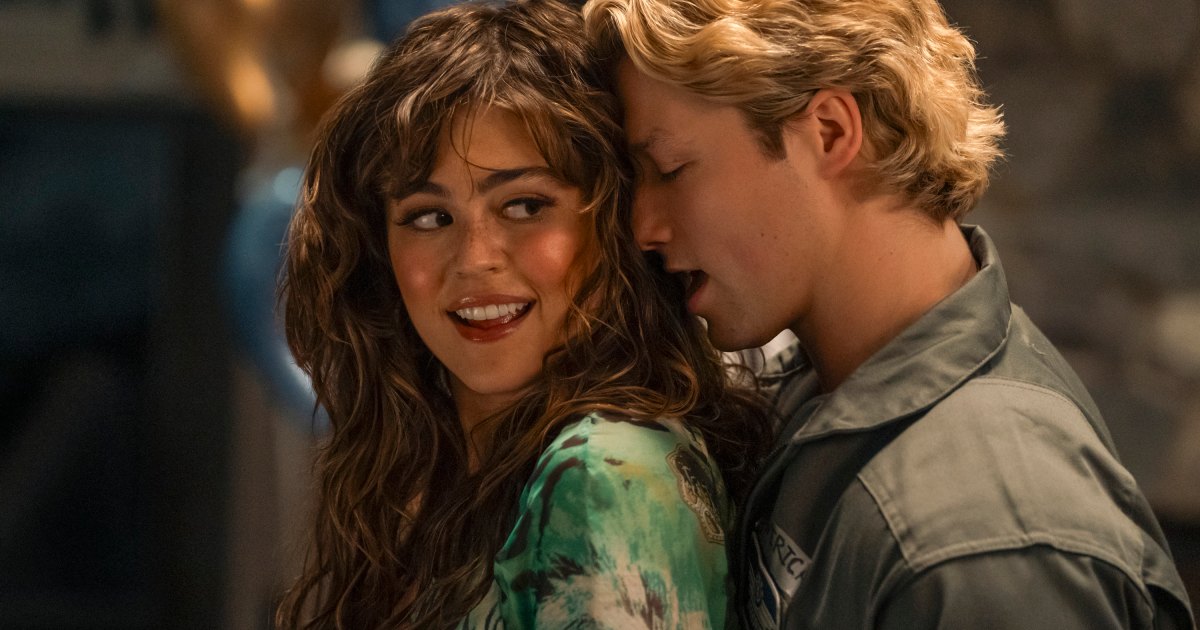
The film follows parents Mihai (Sebastian Stan) and Lisbet (Renate Reinsve) as they relocate their five children from Romania to Lisbet’s secluded hometown in the Norwegian fjords. The integration appears seamless at first: the community is welcoming, and the couple quickly finds work — he at a school, she in elderly care. However, a cultural friction soon emerges. The Georgius’ devout, rigid lifestyle — forbidding YouTube and modern music in favor of strict discipline — stands in stark contrast to local norms. When a teacher spots bruises on one of the daughters, the school triggers a standard child protection protocol. An investigation ensues. Mungiu observes with his signature clinical detachment as the family is dismantled, and their children — including even the youngest one — are removed by authorities pending a resolution.
The formidable Norwegian Barnevernet — an agency capable of dividng a family with bureaucratic ease — has long served as a dark fable of state control within the ostensibly tolerant borders of Europe. Mungiu draws upon the real-world Bodnariu case, which famously laid bare the excesses of Norway’s social services, yet he does so not to document reality, but to instrumentalize it. He strips that real world event of its factual messiness, reshaping it into a narrative that serves his own artistic ends. The result is a cinematic space that feels almost clinically sterile. Within this framework, the snow-dusted fjords and the rhythmic, predictable descent of avalanches function less as nature and more as stage-managed omens of tragedy. This icy, rocky aesthetic permeates the local populace, who speak in such poised, textbook aphorisms that one suspects they have entirely forgotten the chaotic, unscripted nature of life itself.
Mungiu deploys his characters with a surgical exactitude, offering just enough detail to tease the intellect while keeping the emotional core deliberately out of reach. He maneuvers the story into a grey zone that feels remarkably convenient for his directorial style — a space where moral clarity is traded for a carefully manicured cinematic ambiguity. We are invited to observe, never to conclude. We witness the Gheorghiu family through this detached prism: they are strict, at times harsh, insisting on Biblical study while denying their children the secular release of a party. Even Lisbet’s genuine compassion at the care home is layered with the quiet distribution of Evangelical tracts, suggesting that her care is inseparable from her crusade.
Mungiu ultimately places the burden of final judgment on the audience, forcing us to decide whether these domestic rigors truly constitute a moral failing. Simultaneously, he reveals a Norwegian government that seems less preoccupied with the physical safety of the children than with the parents’ refusal to subscribe to a progressive cultural consensus. The film thus evolves into a cold-blooded inquiry into whether a divergent worldview can — or should — be treated as a punishable offense in a society that prides itself on pluralism. As a stark counterpoint to the Gheorghius’ “outsider” status, Mungiu offers the school principal’s daughter — a teenager granted total autonomy but left adrift in parental indifference. Her only leverage for attention is a cycle of manipulation and self-harm, a detail inviting a grim moral calculus: which version of parenting is truly the more negligent? Yet Mungiu seems largely uninterested in providing any answers, or indeed in treating any of his characters as genuine flesh-and-blood humans.
In his hands, the adults become a gallery of the unsympathetic, while the children remain mere ciphers of imperiled innocence. The filmmaker remains only a master of the procedural rather than the psychological; he is far more preoccupied with the grinding gears of social mechanics than with the messy pulse of human suffering. He systematically strips away the warmth that might otherwise invite empathy, a rigidity that is mirrored in the performances. Renate Reinsve & Sebastian Stan (the latter returning to his native Romania as he was originally born there) exercise a monastic restraint, their minimalist approach only occasionally yielding a carefully metered outburst at the director’s command.
Mungiu maintains a self-imposed neutrality so rigid it borders on a creative straitjacket. Yet, that mask of objectivity slips down whenever his temptation to pick apart Norwegian exceptionalism becomes too great: visual cues, such as the Norwegian national flag fluttering pointedly outside the window during a social services visit, becomes a rather heavy-handed irony. There is, of course, a paradox in Mungiu’s admission that he chose Norway precisely because its society is reflective enough to listen; and wealthy enough to fund his critique. It is easy to play the provocateur when the state you are interrogating pays for the privilege.
Ultimately, Mungiu’s choice of “fundamentalism” to deconstruct reveals his own lack of any true neutrality. While his thesis — that state-sponsored overreach and ideological rigidity are universal evils — is seemingly intellectually sound, its application here feels increasingly anachronistic. The real Bodnariu case belongs to a decade-old reality, one that has been eclipsed by the far more visceral horrors of our present moment. In a world once again consumed by the flames of war and the hardening of genuine autocracies, a clinical study of the grievances of religious conservatives in a functional social democracy feels like a reckless dispatch from a distant, safer era. Mungiu calls for mutual respect, but his voice is likely to reach only those who already agree with him, leaving his elegant, frozen frames to feel less like a mirror and more like a relic.
Tamara’s Cannes 2026 Rating: 2.5 out of 5
Follow Tamara on Telegram – @shortfilm_aboutlove
 |