My Hero Academia has become one of the defining manga and anime of its era. Artist Kohei Horikoshi created a world where hero society mixes Japanese storytelling with the spectacle of American superheroes. Since its debut in 2014, the series has grown into a global phenomenon, proving that shōnen manga could succeed by blending cultural influences into something new.
In a 2016 interview, Horikoshi explained that his personal inspirations shaped My Hero Academia from the very beginning. The manga may look like classic shōnen, but its roots stretch across borders. The creator described his deep love of American comics, blockbuster films, and kaiju cinema. These influences quietly guided his storytelling and character work in developing an international superhero project.
A Fascination with Spider-Man and Stan Lee Sparked New Ideas

Horikoshi pointed to Sam Raimi’s 2002 Spider-Man film as his American comic obsession. “Japanese superheroes (like Ultraman and Kamen Rider) transform, but Spider-Man is still Peter Parker inside the costume,” he explained. That difference fascinated him, pushing him to create All Might with an American comic flavor. “Spider-Man is my favorite, especially Superior Spider-Man. Of course, I like Venom too.”
The U.A. High motto, “Plus Ultra!!”, stands as one of the series’ most iconic phrases. Horikoshi admitted it was chosen for its heroic resonance. “Ultra is a familiar word for a hero series,” he said. While not directly taken from Stan Lee, he acknowledged the phrase captured a similar nuance to Lee’s famous “Excelsior.”
How Star Wars Shaped the Mentor and Student Relationships

Horikoshi also cited Star Wars as a foundation for his worldbuilding and character arcs. He filled his settings with puns on Star Wars planets and even sought to capture its crowded Cantina energy in villain scenes. “It strongly influenced how I draw human and teacher-student relationships,” he explained, noting its power beyond spectacle.
Although Western superheroes sparked the project, Horikoshi’s Japanese roots remained essential. He revealed his affection for the Heisei era Godzilla and Gamera films, recalling childhood trips to theaters. His studio shelves displayed figures of kaiju like Destoroyah and Legion among comic heroes.
That mix of inspirations enriched My Hero Academia, giving its villains and monsters a cinematic aura rooted in both Hollywood and Japanese special effects traditions.
An Ongoing Legacy in Anime Even After Manga Conclusion
Horikoshi acknowledged that his artistry drew from manga. He admired Yuki Noshita’s work as the “ultimate form of shōnen manga art.” To improve a panel’s readability, he’d draw slightly smaller, as if pulling back a camera. Even when maintaining dense pages, he insisted on raising quality through painstaking effort. “I do not have shortcuts,” he said, determined to match his peers.
Although the My Hero Academia manga concluded in 2024, its story continues to thrive through anime. An eighth and final season is set for October 2025, showcasing Deku versus Shigaraki and Armored All Might in battle. Vigilantes spin-off anime debuted in April 2025, with a second season already announced. The My Hero Academia world continues evolving on screen.
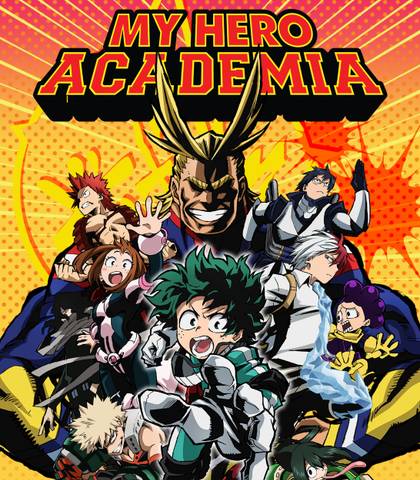
- Movie(s)
-
My Hero Academia: Two Heroes (2018), My Hero Academia: Heroes Rising (2019), My Hero Academia: World Heroes’ Mission (2021)
- First Film
-
My Hero Academia: Two Heroes (2018)
- Cast
-
Daiki Yamashita, Kenta Miyake, Nobuhiko Okamoto, Ayane Sakura, Yûki Kaji, Aoi Yuki, Kaito Ishikawa, Toshiki Masuda, Marina Inoue, Yoshimasa Hosoya
- TV Show(s)
-
My Hero Academia