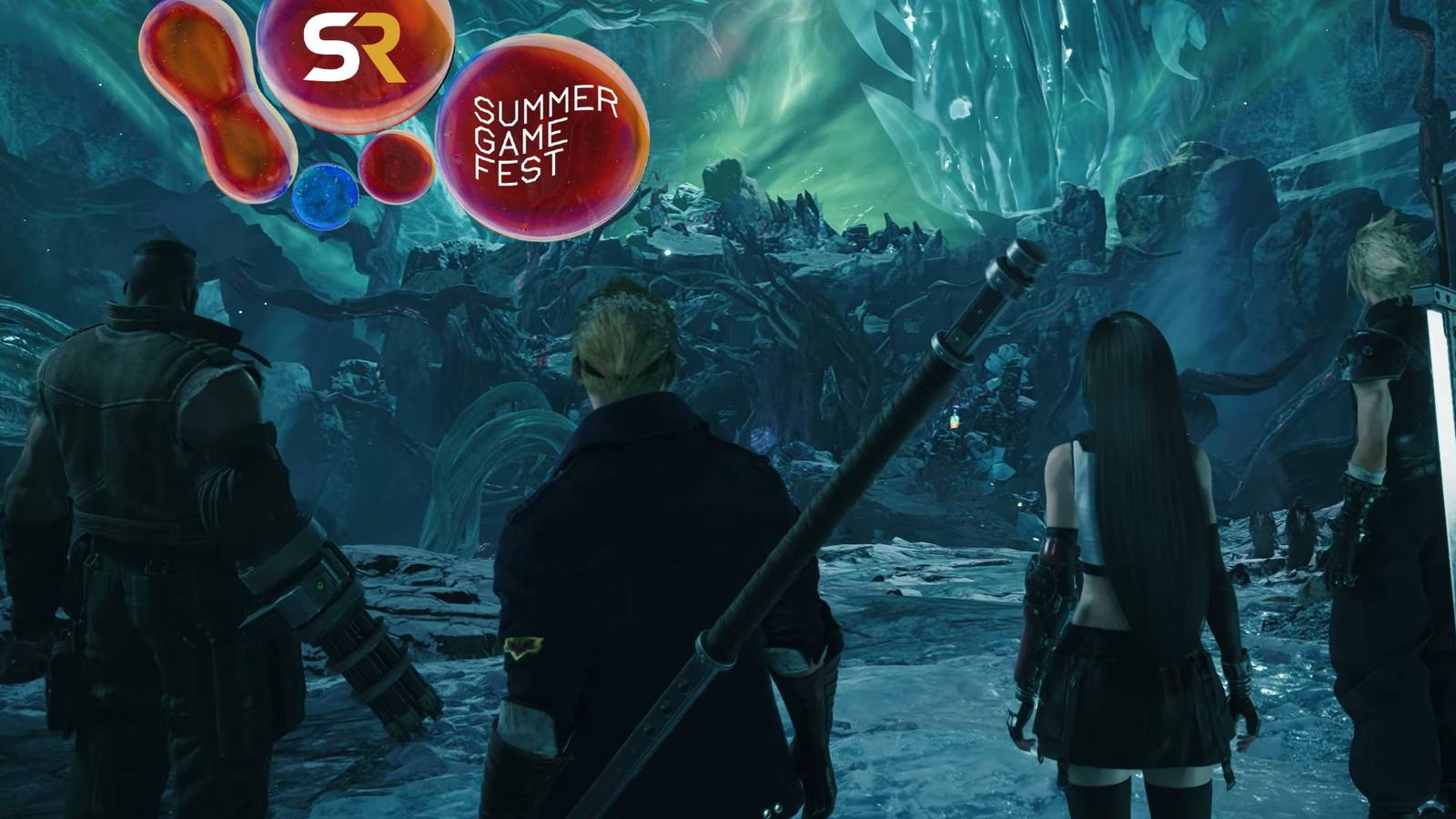
Final Fantasy 7 Revelation was quite the surprise when it was revealed at the Summer Game Fest (SGF) Opening Night Live showcase. While we knew it was inevitably coming at some point, actually seeing the announcement, and that it’s potentially less-than-a-year away, is a bit different.
The trailer wasn’t brief either, as we got to see full Highwind gameplay and a ton of footage. We also learned that it was coming to PC, PS5, Switch 2, and Xbox Series X/S at launch (eschewing the previous timed PlayStation 5 exclusivity) was the cherry on top.
There’s a lot to dig into with FF7 Revelation, and we were prepared when we had the chance to talk to co-director Naoki Hamaguchi about how the trilogy got here, and what to expect.

Given that Final Fantasy 7 Revelation will have full platform parity at launch, it was something worth looking into. Hamaguchi was open to talk about it: “The biggest reason why we’re taking a platform parity approach isn’t really about our preference as creators…there’s no technical hurdle…it was more strategically approached as a company. With our [current CEO] the general goal is to achieve platform parity, and have our titles launched on multiple platforms on day one.”
“Previously, there was a platform exclusivity deal with SIE, so our goals have shifted a bit, and we’re looking to achieve platform parity on day one.” Following up, I asked Hamaguchi whether his team would have preferred to have worked out platform parity day one, and he had a thoughtful answer.
“That’s an interesting question. Say we didn’t have to worry about how Square Enix as a company…the strategic approach they might have…putting all that aside as a creator I’d want to offer my titles to as many players as possible. There’s nothing more you can ask of as a creator to set up an environment where everyone can enjoy them…including setting up the PC platform, it’s a much more modern approach. If I had a choice, I’d take that approach as well.”

We talked with Hamaguchi in the past about the porting process with FF7 Rebirth, and it turns out the studio has learned even more since then: “I think, you know through the trailer, the footage we’ve shown, it’s easy to tell that it wasn’t an easy feat to achieve all that for all the different consoles. One thing I can say is having the experience of the porting process, of Rebirth to Xbox and Nintendo Switch 2, that was a tremendously valuable experience that we were able to leverage for FF7 Revelation.”
“We launched the ports of FF7 Rebirth just a few days back, and the reception seems to be pretty positive so far, which is great to see, but having that insight of how the porting process works, that was a huge asset for us and throughout the development of Revelation.”
Hamaguchi expands on that thought, providing an interesting insight into the industry’s reaction to ports and exclusivity: “One thing I noticed is that there’s a global difference of how fans respond to the porting process. In the west, the reaction to ports is often positive. Whereas some Japanese players have this mindset that something as epic and grand as Final Fantasy should be reserved for a powerful console, like the PlayStation.”
He continues, talking about how the reaction has grown more positive over time: “So sometimes the common feedback we see from Japanese consumers is that if it launches on the same day as say, Switch 2, the quality will be hindered. Some people see it this way. But Revelation, we did see a handful of feedback from Japanese players that was more positive, and I think it was because we were able to launch a strong port for Remake and Rebirth. So the quality won’t be hindered.”

Given that the Highwind is going to introduce a whole new open world element to the game, I asked whether Revelation would employ a chapter-based format, which Hamaguchi confirmed: “So, in terms of how the main story plays out it’s going to take a similar approach as we did for Rebirth, in the sense that we’re taking the chapter approach.”
“When we looked at how players engaged with the main story in Rebirth, there were a lot of people who didn’t want to leave areas without completing every single thing…early on in the game, players get access to the Highwind. Once they do they can go to a variety of areas immediately after that, like the Grasslands, Junon, Correl. Within each of those regions, there are different areas where we’ll have different suggested levels. So some areas in that region might be more difficult than others.”
“So players will have to make that choice if they want to save those areas for another time. If players try to approach it like Rebirth and complete everything, it’s going to take a long time. But the player choice of what order to take in everything is customizable and based on the playstyle each player will have.”
“Looking back at these last 10 years, it was constant hustling”
As it turns out, developing a massive trilogy of remakes takes time. Hamaguchi talks about how the team approached this lengthy development cycle, and the lessons they learned along the way:
“It’s very much a series of ambitious titles…a trilogy of three AAA titles…it’s an incredibly difficult thing to do. And most other developers would probably agree with that. As it turns out it took us about a decade…we were aware that the technological limitations would change as we progressed. With Remake we were focusing on implementing what we were able to do at that time with the limitations we had. In terms of what we wanted to do with Rebirth and Revelation, we didn’t have a concrete idea back in the era of Remake.”
“We knew what would be possible would change in next several years. We focused on creating Remake first, then Rebirth and Revelations after that. But at the same time if we were to start from scratch after Remake it would have taken us a much longer time. We started thinking about what we wanted to do with Rebirth one year before Remake, at least. That approach and the fact that we were able to retain our core development team between the three titles was a huge factor for us being able to achieve this long, but smooth journey of releasing all of them.”

“Looking back at these last 10 years it was constant hustling,” Hamaguchi confides. “The entire Final Fantasy 7 franchise, it’s something I greatly admire as a fan, so we’re confident this final installment is going to be incredible, but at the same time we wanted to make sure we didn’t deliver something half-hearted. So there was a sense of pressure at all times to deliver for fans. We’re still working on the game, it’s not quite complete yet, but it’ll be something fans will love.”
Closing out our interview, I asked Hamaguchi about potential postgame details, and what players can expect beyond the main story. Bringing up my history with the series, I mentioned that seeing Ruby and Emerald Weapon (two of the game’s superbosses) for the first time, they blew me away with how strong they were at first glance, and gave me a reason to power up and come back.
He surprisingly gave us a pretty good endgame tease for Final Fantasy 7 Revelation: “Yes, there will be a lot of boss fights at the end, strong boss fights, not just Weapons, but Knights of the Round, which a lot of the fans of the original are looking forward to in the Remake series, so there will be a lot of those boss fights after they finish the game.”


- Released
-
February 29, 2024
- ESRB
-
Teen / Violence, Blood, Mild Suggestive Themes, Language, Use of Alcohol and Tobacco
- Developer(s)
-
Square Enix
- Publisher(s)
-
Square Enix
- Engine
-
Unreal Engine 4