

The Frighteners has a special place in my moviegoing history because it was the first movie I ever saw in one of those stadium-seated AMC theaters. Before that, I was used to twin theaters where you walked in, picked one of two screens, and hoped some six-foot guy didn’t sit directly in front of you. Walking into a huge AMC in 1996 and seeing all those seats rising up felt like the damn future. So yeah, I was probably going to remember this one no matter what.
It also helps that The Frighteners freaking rips. Not perfect, not some secret masterpiece everyone in 1996 was too stupid to understand, but awesome. Michael J. Fox plays a crooked paranormal exterminator running scams with his dead buddies, John Astin is a decomposing old pervert trying to bone a mummy, R. Lee Ermey is basically still in Full Metal Jacket after death, Dee Wallace and Jake Busey get to go very dark, and Jeffrey Combs shows up looking like Gary Oldman got lost on the way to The Fifth Element. Peter Jackson is directing all of this years before Middle-earth, Robert Zemeckis is backing him, and Weta is trying to pull off effects on a scale the company had never handled before.
Universal liked what it saw enough to move the movie out of its planned Halloween window and into the summer. Then Jackson got an R rating he didn’t want, Independence Day was still eating everything alive at the box office, and the movie opened on the same day as the Atlanta Olympics opening ceremony. For all that it had going for it, The Frighteners couldn’t find much of an audience. So why did a movie Jackson intended as a PG-13 wind up getting slapped with an R? How did a box-office disappointment wind up becoming an important stepping stone toward The Lord of the Rings? And how did something this entertaining get stuck between a horror movie, a comedy, and a summer blockbuster? Let’s head back to Fairwater and see what the hell happened to The Frighteners.
PETER JACKSON GETS A BIGGER CHECK
Before the hobbits, Peter Jackson had made Bad Taste, Meet the Feebles, and Braindead, released here in ‘Murica as Dead Alive. If you knew him from those movies, you probably weren’t expecting him to become one of the biggest directors in the world. I love that early stuff, but a movie where a lawnmower gets put to that kind of use isn’t usually the one that gets a studio interested in handing you a bigger budget.
Heavenly Creatures changed things in 1994. Jackson and Fran Walsh earned an Oscar nomination for their screenplay, and the film showed a much wider audience what he could do with actors and a story that didn’t depend on how many bodies he could tear apart. It still had plenty of the visual imagination and disturbing material from his earlier work, which would carry over into The Frighteners.
Jackson and Walsh were developing the ghost story while Heavenly Creatures was coming together. Their agent passed the idea to Robert Zemeckis, who was looking at possible Tales from the Crypt features. Zemeckis eventually felt it should be a separate movie, especially after the box-office failure of the fun Bordello of Blood, and he came aboard as executive producer with Universal backing the production. Having the director of Back to the Future and Forrest Gump involved gave Jackson some valuable support, particularly on a film that was going to need so much effects work. Jackson was firm about where he wanted to make it, though. He later said he wouldn’t have done the movie if it meant leaving New Zealand. He and Walsh were writing for a bigger audience, but they would make the film at home with the team they were building there.
MARTY MCFLY HAS SEEN SOME SERIOUS SHIT
Frank Bannister is a great Michael J. Fox role because the guy is kind of a piece of shit when we meet him. His wife is dead, his life has pretty much stopped, most of the town thinks there’s something wrong with him, and he’s living in a half-finished house while using his ability to see ghosts to rip people off. Frank sends his dead buddies into people’s houses to cause trouble, then shows up with fake ghostbusting equipment and charges to get rid of them. It’s a great setup because he really can do the thing he’s advertising, but he’s still running a scam. Somehow that makes it even better.
Fox is a huge part of why this works. Frank can be funny and charming while he’s trying to get money out of somebody, but there’s a tiredness to him that stays with the character even during the comedy. You can see how little he has going on once the job is over and he has to go home. That gives Fox somewhere to take the performance as we learn more about his wife’s death and the movie gets darker. Frank is already living with something he hasn’t dealt with, so it makes sense that the new deaths around town would force him to confront it. Fox keeps that part of the character present without making the early scenes miserable to sit through.
The supporting cast gives him plenty to work with. Chi McBride plays Cyrus, and you probably know him from movies like Gone in 60 Seconds or Waiting…. Jim Fyfe is Stuart; he had already appeared in A Kiss Before Dying and would later turn up in The Real Blonde. Then there is John Astin as the Judge. Most people are always going to know Astin as Gomez Addams, but he had also been in Freaky Friday and National Lampoon’s European Vacation. The three ghosts helping Frank with his business bicker and get on each other’s nerves enough that you buy them as a group, which matters when they are sharing scenes with a living actor who has to make all these effects feel believable. Astin is particularly fun as the Judge, who is physically falling apart but still finds time to pursue a mummy. There is also a nice bit in the outtakes where Fox keeps calling him Doc. Given how much time Fox had spent working opposite Christopher Lloyd, you can understand how that one slipped out.
Trini Alvarado, who had just been in Little Women and The Perez Family, plays Lucy Lynskey, the doctor who gradually realizes Frank isn’t completely full of shit. Peter Dobson is her husband Ray, an obnoxious health nut who remains a nuisance after he dies. Dobson had been in Zemeckis’ underseen TV show Johnny Bago and played Elvis Presley in Forrest Gump, which is a pretty good pair of credits to bring into a Peter Jackson ghost movie. Lucy’s last name is a nod to Heavenly Creatures star Melanie Lynskey, who turns up briefly as a deputy, while Jackson appears as the pierced guy Frank bumps into on the street. Then there is R. Lee Ermey, already impossible to separate from Full Metal Jacket and fresh off Se7en, as a military ghost barking orders in the cemetery. If you wanted more of that drill-instructor energy, he gets to do a supernatural version of it here. The cast is full of people who can make an impression with a fairly small part, and that helps keep the town interesting as Frank moves through it.
NEW ZEALAND PLAYS AMERICA
That town was put together in New Zealand, with Wellington and Lyttelton standing in for the fictional American community of Fairwater. I really like the way the locations look in this movie. Lyttelton’s hills and harbor give it a different feel from the familiar streets you tend to see in American studio productions, and Jackson uses that geography well. There was still a lot of work involved in making it pass for America. The production had to dress locations and change signs, with miniatures helping fill out the town. Filming ran from May into November of 1995 and was disrupted when cinematographer Alun Bollinger was badly injured in a car accident. John Blick stepped in, Bollinger later returned, and the two shared the cinematography credit.
Jackson’s camera is just as active as you would expect if you’ve seen his earlier movies. He gets close to faces, shoots from low angles, and moves quickly through spaces, which suits a story where something can come at you through the wall.
WETA HAS TO FIGURE IT OUT
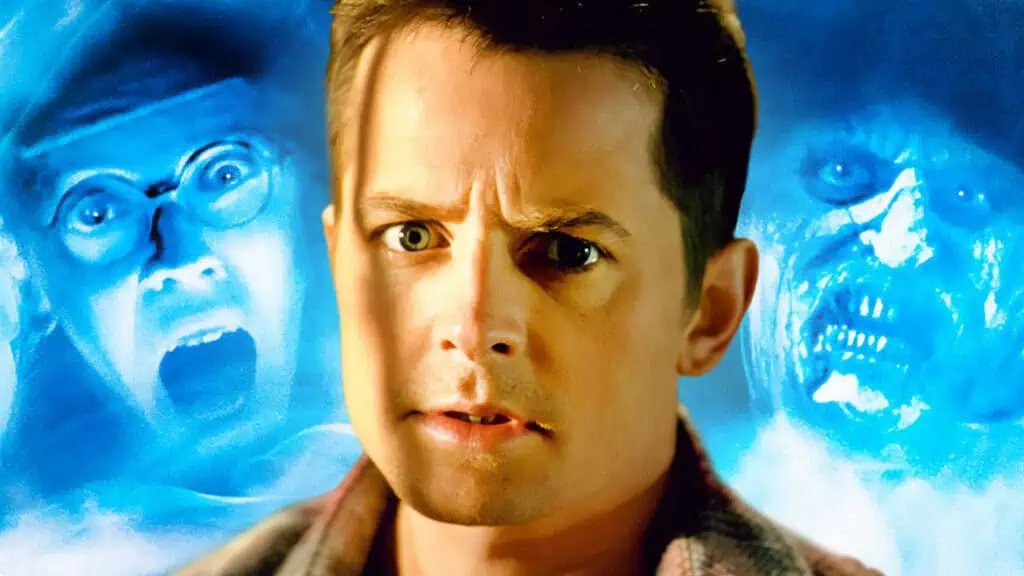
That also meant a lot of work for Weta Digital. The company had worked on Heavenly Creatures, but The Frightenersrequired digital characters to appear throughout the movie and interact with the cast and their surroundings. Cyrus, Stuart, and the Judge couldn’t just show up for a brief scare and disappear. We had to spend time with them, understand where they were in a room, and accept that Fox was having conversations with them.
By the end, Weta had more than fifty effects crew and forty networked computers, with software being written to handle particular problems. Matt Aitken later recalled delivering 570 effects shots. He wrote software for the figures moving underneath walls and other surfaces, while Wayne Stables developed tools to combine the ghost images with the live-action photography. Moving all that image data around was difficult enough that the team physically passed shots between departments on tapes. The Grim Reaper caused its own problems. It began as an elaborate puppet, but the movements Jackson wanted eventually pushed the character toward digital effects, including the difficult business of making its black robe move properly.
Some of that CG has aged, of course. The ghost glows can get heavy, and some of the morphing has the rubbery look you associate with effects from that period. It doesn’t bother me much here because I still like what Jackson is doing with it. A grim reaper pushing through wallpaper is a great fucking image, and the effects let him stage scenes he couldn’t otherwise have attempted. The ghosts also have enough personality that I care about them beyond how convincing they look. Once we find out that Johnny Bartlett can hurt Cyrus and Stuart even though they’re already dead, the danger becomes more immediate. We’d spent the earlier part of the movie enjoying their company, so there’s a reason to worry about what happens to them.
SOMEBODY CHECK ON JEFFREY COMBS
Of all the supporting performances, Jeffrey Combs is probably the one people bring up most, and understandably so. Horror fans already knew him from Re-Animator and From Beyond, and Milton Dammers gives him another character he can take right to the edge. He plays an FBI agent whose years undercover with cults have left him deeply disturbed. Dammers doesn’t walk into scenes so much as invade them. He’s convinced Frank is involved in the murders, has trouble dealing with women who raise their voices, and seems uncomfortable in almost every interaction. Combs helped develop the Hitler-inspired haircut and the appliances that pushed his ears forward, while the hemorrhoid cushion Dammers carries was made from a wheelbarrow inner tube. It’s an absurd amount of detail for a supporting character, but Combs makes use of all of it in the way he stands, stares, and approaches people.
What makes Dammers work is that he can actually cause problems for Frank. He’s an unstable man with federal authority, and his certainty that he’s found the killer gets in the way of figuring out what’s happening. Combs goes so far with the performance that Fox mostly has to react to him, which is a good use of both actors. Frank already looks worn down before Dammers starts making his life worse. I can see how the character might be too much for some viewers, especially with everything else going on, but for me, Combs is one of the best things in the movie.
DEE WALLACE GETS TO BE THE PROBLEM
Dee Wallace gets an equally good role as Patricia Bradley. At first she seems like someone who needs help, stuck in a creepy house with a controlling mother played by Julianna McCarthy, who had appeared in Striking Distance and would later show up in Starship Troopers. Wallace had spent enough time in movies like E.T. and Cujo that it was easy to worry about her as soon as she appeared. That makes the revelation of Patricia’s involvement with Johnny Bartlett more effective. Jake Busey, who had just appeared in Twister and would be in Starship Troopers the following year, plays Johnny as a murderer who is proud of what he’s done and still obsessed with his body count after death. When Patricia drops the frightened behavior, we see how much she enjoys being with him and how willing she is to take part. Wallace suggested that Patricia should seem younger as Johnny draws her back into their relationship, and you can see that change in the excitement she brings to their scenes together.
Wallace was dealing with something awful in her own life during production. Her husband, actor Christopher Stone, died while the film was being made, and she traveled between New Zealand and the United States before returning to finish her work. She has spoken warmly about how Jackson and the crew treated her and her daughter during that time. The production covered the travel, and when her daughter wanted to try the flying work her mother was doing, the effects team built a small rig for her. Wallace has described Patricia as some of her rawest work. Knowing the circumstances gives you an appreciation for what she was managing while delivering such a demanding performance.
A COMEDY WITH A BODY COUNT
By the time Johnny and Patricia take over, The Frighteners has moved a long way from Frank charging people to remove his friends from their houses. I like that progression. The scam is a fun way into the story, but staying with it for the whole movie would have wasted a lot of what Jackson and Walsh had set up. Frank has to deal with what happened to his wife, Lucy is in danger, and the people responsible are more disturbing than the hooded figure we’ve been watching. To me, that doesn’t feel like the movie losing control so much as Jackson finally revealing how nasty this thing was always capable of getting. Fox carries us through the change because Frank’s grief was there from the beginning, and Wallace and Busey commit completely to how awful these two people are.
I can still understand why the changes in tone threw some viewers. Ray dies and the movie keeps getting laughs out of him, then we’re following people who are trying to escape a serial killer. Anyone expecting a fairly light Michael J. Fox comedy had to adjust. Danny Elfman had to account for that in the music, too. Heavenly Creatures had made him want to work with Jackson, but he later described The Frighteners as difficult to score because its tone was hard to pin down. The music moves between the ghost comedy and the more threatening material, and I think it does a good job of keeping up with the film without making the transitions feel even more abrupt.
The rating created another problem. Jackson originally wanted a PG-13, but according to his making-of account, the ratings board was objecting even to the number of shotgun blasts through a door. Once he accepted that the film was going to get an R, he made Dammers’s death more graphic, so Combs gets his head blown apart. The R suited the nastier material, but it complicated the audience Universal could reach. Fox and the funny ghosts could appeal to younger viewers who now needed an accompanying adult to see it, while people looking for a more straightforward horror movie had to get through a substantial amount of comedy. That’s a combination I enjoy, but I can see the difficulty in selling it to a broad audience.
THE SUMMER RELEASE GOES BADLY
Universal had originally planned a release around Halloween, then moved The Frighteners into the summer after liking what it saw. With Fox starring, Zemeckis producing, and a large amount of visual effects work, the studio had reasons to think it could compete. The actual release date was July 19, 1996, the same day as the opening ceremony of the Atlanta Olympics. Independence Day was still number one in its third weekend, while Phenomenon, Courage Under Fire, and The Nutty Professor also finished ahead of The Frighteners. It’s tempting to blame the Olympics, but contemporary reporting questioned whether the Games were hurting moviegoing nationwide. The competition and the difficulty of finding the right audience for this particular movie deserve attention, too.
The Frighteners opened in fifth place with about $5.6 million from 1,669 theaters. It did better than the other new wide releases that weekend, including Fled, Multiplicity, and Kazaam (not the Sinbad genie movie—that’s Shazaam urban legend territory!). The number was still disappointing for a production of this size. The second weekend fell roughly fifty percent, and the film finished with about $16.8 million domestically and $29.4 million worldwide. Universal had initially greenlit it at a reported $26 million. Around $30 million became the commonly cited final budget, although contemporary Los Angeles Times reporting put the cost as high as $38 million. Even using the lower estimates, the worldwide gross was a poor result once you account for theaters keeping a share of ticket sales and the additional expense of marketing.
Critics were split as well. Roger Ebert felt the effects overwhelmed the movie and compared it to a demo reel. He also said he’d rather watch a nine-hour documentary about Mongolian yak herders, which seems a little harsh to me. The Austin Chronicle was more receptive to Jackson’s imagination and Combs’s performance, even while acknowledging how chaotic the movie could be. The things that made some people love it were already putting other people off in 1996. I don’t think an October release would have solved every problem, but a horror comedy this strange seems better suited to Halloween than a summer where Independence Day was still drawing such large crowds.
THE GHOSTS STICK AROUND
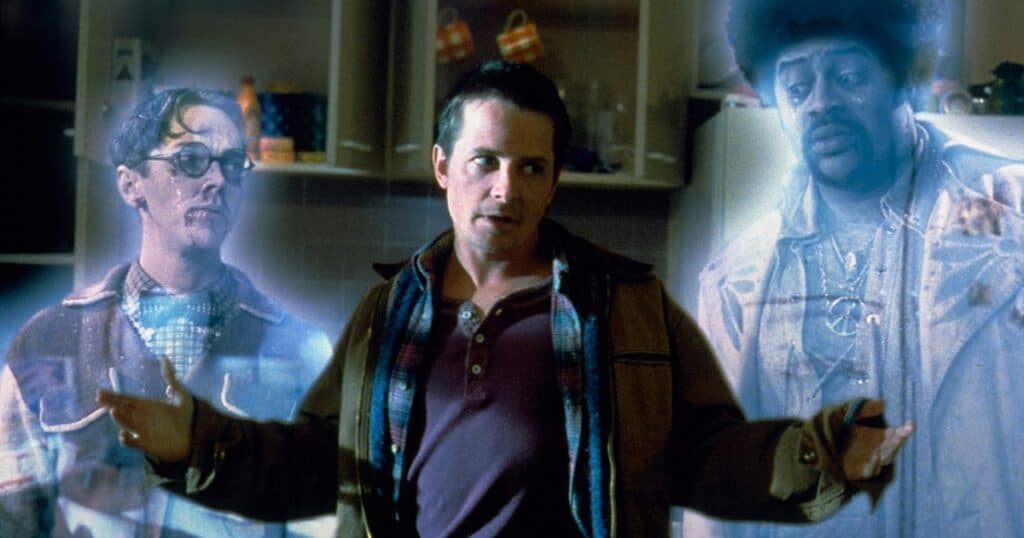
The Frighteners would become Michael J. Fox’s last leading role in a live-action feature, although the box office doesn’t explain that on its own. He returned to television with Spin City in 1996 and continued working in voice roles and later television appearances.
Jackson, meanwhile, had begun investigating the Tolkien rights while The Frighteners was still in production. His team also spent time developing a King Kong remake before Universal put his version on hold. Getting The Lord of the Ringsmade would involve years of development, false starts, and questions about whether Jackson and his New Zealand effects company could handle the scale of it. The Frighteners gave them work they could point to when those questions came up. Weta had completed hundreds of effects shots, built digital characters, and developed tools for combining them with live-action footage. Matt Aitken later described the film as essential to convincing people that Weta could take on Rings.
The Frighteners also found a more appreciative audience on home video. The 1998 Signature Collection LaserDisc included an extended version and a making-of documentary running around four and a half hours. If you wanted to know how Jackson and the crew had made the thing, there was plenty to get through. The director’s cut and those extras reached DVD in 2005, and Turbine later released a Jackson-approved restoration of both versions with more cast and crew material. There’s also a brand-spanking-new 4K coming out from Arrow Video this month you can buy RIGHT HERE! Jake Busey has also said the Duffer brothers wanted him for Stranger Things because they liked his performance in The Frighteners. That’s a nice example of the movie continuing to reach people well after its initial release.
More importantly, the movie itself has aged into exactly the kind of thing I wish studios would make more often. It’s weird, funny, nasty, and sad without feeling like every decision got smoothed down until nothing interesting was left. Some of the effects look their age and the tone goes all over the place, but I wouldn’t really want to smooth any of that out. Fox gives us a reason to care about Frank, Combs is a blast to watch, Wallace gets to do something very different from the roles people tend to associate with her, and you can still feel the Peter Jackson who made those earlier splatter movies even with a much bigger studio budget behind him.
For me, there’s always going to be that extra memory attached to it, too. I can still connect The Frighteners with walking into that stadium-seated AMC after years of twin theaters and feeling like moviegoing had suddenly gotten bigger. Luckily, the movie on the screen felt bigger, too. Universal didn’t get the hit it wanted, but Jackson and Weta came away with experience that would prove useful on much larger films, and the rest of us got one of the strangest Michael J. Fox movies ever made. For anyone who discovered Jackson through The Lord of the Rings and hasn’t gone further back, this is absolutely one I’d recommend. And that’s what happened to The Frighteners.
The post How Peter Jackson’s The Frighteners Flunked the Box Office—and Paved the Way for Lord of the Rings appeared first on JoBlo.